Why Operational Excellence Is Becoming Hospitality's Biggest Competitive Advantage
Various businesses in the hospitality industry regard their operational discipline as an important tool in keeping the quality of service during the peak periods, managing costs effectively, and adapting to changing customer preferences.

Published by — Guest author
Views: 12 11 MIN READ
In today’s hospitality landscape, unique designs and creative ideas are not enough to guarantee success in the market. Guest expectations have become more result-oriented, more personalised, and experience-driven than ever before. At the same time, aesthetics and novelty alone won’t be enough to create a long-lasting customer loyalty. ICRA expects the Indian hospitality industry’s revenues to grow by 7-9% YoY in FY2027 following 9-12% growth in FY2026, highlighting that disciplined operations remain the key ingredient to sustaining growth even in a healthy demand environment.
As a result, the strategic differentiator is now operational excellence. It provides the invisible framework that enables businesses to deliver consistent, high-quality experiences at scale. When it comes to deciding the strongest drivers of brand differentiation in an era where experiences can be shared on social media and customers have endless options, consistency is the name of the game. A beautifully designed space won’t make modern customers overlook service failures. The combination of rising operational costs along with persistent workforce has now pushed operational excellence an essential business policy.
The Operating Framework
To truly understand operational excellence, we first need to understand the elements that support the concept.
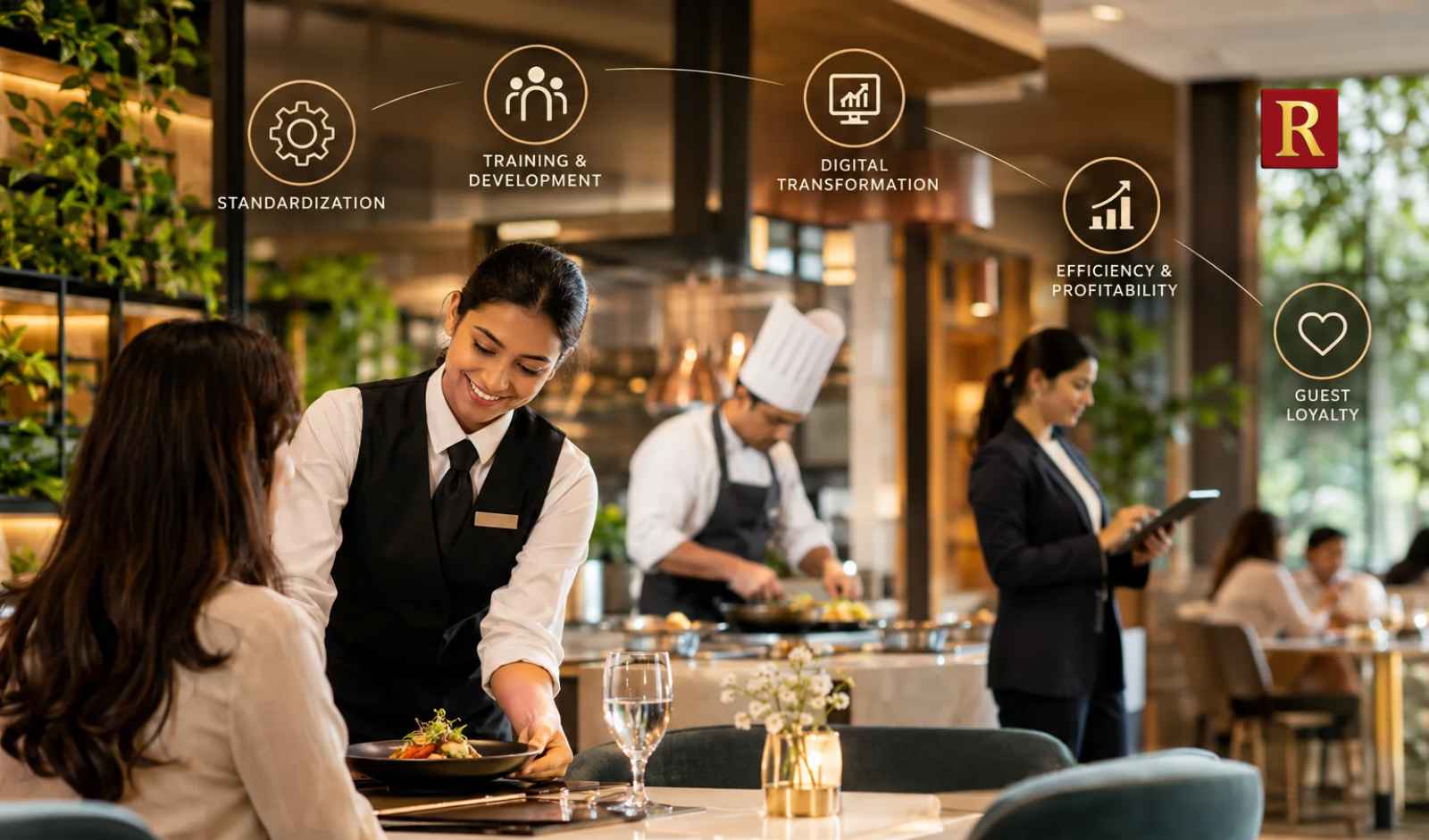
Standardization is key. It primarily includes clear, repeatable and easy to use procedures for the staff in charge of running the kitchen and serving the guests. In addition, it makes it possible to achieve a consistent quality in services provided without compromising creativity. Consistency is essential as the guests want to be sure that the quality is always high regardless if they pay a visit now or return later. Moreover, workforce training and skills upgrade is a must in this situation.
Another crucial point is developing the workforce through constant training of the employees. As stated in Deloitte’s Global Hospitality Outlook 2026 report, the overwhelming 81% of hospitality executives agreed on the need for improvement in terms of productivity. In turn, productive employees will help to use the well-designed space and provide customers with a memorable experience.
Finally, digital transformation is also changing the hospitality industry and operators increasingly use AI for demand forecasting, pricing optimization and different aspects of guest service.
The Business Case
The impact of operational excellence on business performance is both measurable and significant. It strengthens cost management through reducing waste, managing inventory better, and allowing more efficient workforce planning which ultimately leads to the protection of profitability without sacrificing customer service.
Operational excellence is valuable because it helps to gain a competitive advantage that is hard to replicate. In the current hospitality industry, consistent performance is one of the key differentiators of value. Customers rely on brands that can consistently produce quality products and provide good service. In the modern world where every customer’s feedback can create a huge impact on future customers, operational consistency is essential for brand reputation and building loyal customers.
Operational excellence allows brands to offer high-quality customer experience while maintaining strong margins. The companies that can mix creativity with operational practice will be successful in the future.
The Real-World Impact
The benefits of operational excellence become clear in the hospitality industry. Companies with established operational systems often receive higher guest satisfaction levels, customer retention rates, better operational efficiencies, and superior financial results. Various businesses in the hospitality industry regard their operational discipline as an important tool in keeping the quality of service during the peak periods, managing costs effectively, and adapting to changing customer preferences.
The most essential benefit relates to the aspect of trust which is built through operational excellence. If the operations are effective and user friendly, any company can deliver a high-quality service to improve the relationship with customers.
Why People Remain at the Heart of Operational Excellence
Processes, systems, and technology are all essential components of operational excellence, but ultimately, it is people who drive its effectiveness. Modern systems will only achieve their full potential with the backing of skilled, motivated, and empowered teams.
Thus, I believe that leadership is a key aspect in creating a culture of accountability, ownership and continuous improvement. In the hospitality business, where people are at the heart of it all, the quality of services is determined by empowered and confident staff. A motivated workforce is resilient and able to maintain great service according to established standards even during busy times, when there are unexpected problems, and also when customer demands are constantly changing.
In essence, operational excellence is about involving people in business. Successful hospitality brands recognise that investing in employee development is not simply a cost, it is the foundation of sustainable growth, operational resilience, and lasting customer loyalty. Technology may keep on changing the industry, but the human element remains the most vital in the hospitality business.
Operational excellence is the way ideas turn into action. As the hospitality industry continues to evolve, businesses that invest in robust operating systems, knowledge sharing, technology, and skilled people will be best positioned to adapt, scale, and succeed. Those that recognise operational excellence as a strategic capability rather than simply an efficiency initiative will be the ones that shape the future of hospitality.
Ultimately, in an industry built on experiences, operational excellence is what transforms one memorable visit into lasting customer loyalty and that is the strongest competitive advantage any hospitality brand can build.
Aditi Tihara, Senior Vice President, True Palate Hospitality