
Key Clauses Every Restaurateur Must Understand In A Restaurant Lease Agreement
A restaurant lease is more complicated than a typical office or retail lease since it must deal with expensive infrastructure requirements (gas, water, and exhaust), strict operating hours, and special licensing requirements. A single poorly drafted clause can end up in operational shutdowns, crushing financial consequences, or a total loss of investment.

The idea of starting a restaurant is often coupled with thoughts of vibrant dining areas, creative cuisine, and excellent reviews. However, transforming that idea into an actual business depends on a crucial but sometimes disregarded document: the commercial leasing agreement. A lease is the blueprint for a restaurateur's future operational, financial, and legal life; it is more than simply a space agreement.
A restaurant lease is more complicated than a typical office or retail lease since it must deal with expensive infrastructure requirements (gas, water, and exhaust), strict operating hours, and special licensing requirements. A single poorly drafted clause can end up in operational shutdowns, crushing financial consequences, or a total loss of investment.
What is a Restaurant Lease Agreement?
A legally binding agreement between a restaurateur (lessee) and a landlord (lessor) gives the tenant the exclusive right to use a commercial space for running a food and beverage (F&B) business.
The Transfer of Property Act of 1882 and the Indian Contract Act of 1872 are the main laws that regulate commercial leases in India. Since the majority of business contracts last longer than 11 months, they must be stamped and registered in accordance with the Indian Registration Act of 1908 to be accepted as evidence in court. To protect the restaurateur's rights and investment, this procedure is essential. The provisions of the agreement are quite customizable and include every aspect of the lease, from the basic rent to the ability to install a grease trap.
Read more: Why the Buffet is the Perfect Meal for Corporate Events
Understanding the Types of Commercial Leases
For a business like a restaurant, which is known for having extremely narrow profit margins, the kind of lease determines who is responsible for covering the property's operational costs over and beyond the basic rent.
1. Gross Lease (Full-Service)
The renter in a gross lease makes a single, set rent payment. The majority of the property's operational costs, such as building insurance, property taxes, and structural upkeep, are the landlord's responsibility. For new, small businesses looking for fixed, total expenses, this is perfect.
2. Modified Gross Lease
In a modified gross lease, the landlord and tenant negotiate which exact running costs will be covered by each side, balancing their responsibilities. Major costs like insurance and property taxes are usually covered by the landlord, although the renter may be responsible for certain interior maintenance and utilities. This provides a compromise between simpler budgeting and cost control.
3. Triple Net Lease (NNN)
In commercial real estate, the Triple Net (NNN) Lease is the most common and imposes the most financial strain on the tenant. Three "nets" are paid by the tenant in addition to the base rent: maintenance expenses, insurance, and property taxes. A business plan can be swiftly wrecked by unforeseen taxes or maintenance expenses, so a restaurant has to be extremely mindful of this structure. Long-term renters who want control over maintenance or well-known businesses frequently like this.
4. Percentage Lease
In places with a lot of traffic, such as malls, a percentage lease is usually used. Tenants are required to pay a reduced base rent in addition to a portion of gross sales above a certain "breakpoint". With this arrangement, the restaurant can match its leasing expenses to its income statistics.
Know more: 7 Tips to Maximise Sales in Your Restaurant
Operational Rights: Securing Your Core Business
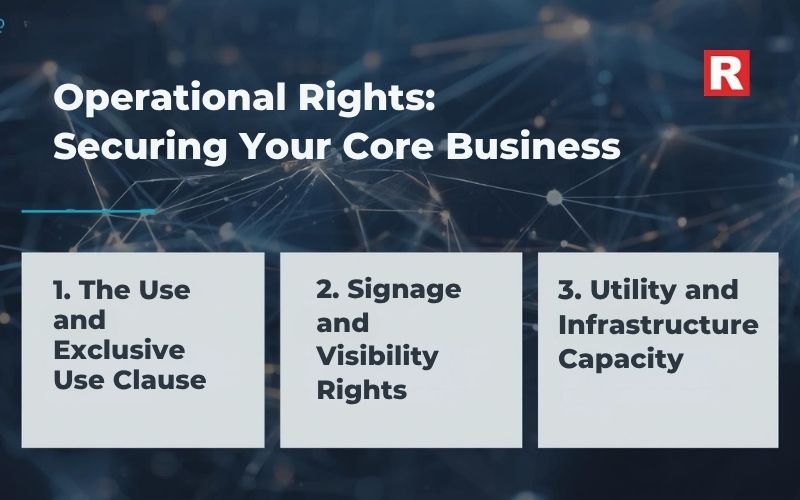
These provisions guarantee that you can operate a restaurant lawfully and practically without hindrance.
1. The Use and Exclusive Use Clause
Not simply "restaurant," but also "takeaway," "delivery," "catering," and—above all—"alcohol service" must all be explicitly permitted under the Use Clause. An F&B business's most important safeguard is the Exclusive Use Clause. For example, it stops a rival coffee shop from operating next to your café by preventing the landlord from renting space to a direct competitor in the same commercial property. Therefore, it is important to define a "direct competitor" precisely.
2. Signage and Visibility Rights
The visibility of your business increases foot traffic. It must be specifically permitted under the lease to put up visible and clear signage on the directory boards, poles, or exterior. Because landlords frequently enforce strict rules for aesthetic control, bargain up front about the size, placement, and any limitations (such as lighting and design).
3. Utility and Infrastructure Capacity
A restaurant requires a lot of infrastructure. Sufficient Electrical Load (enough three-phase amps for commercial cooking equipment), Gas and Water Supply, and—most importantly—Exhaust and Ventilation Rights (clear authorization to pierce the roof or wall and install a commercial exhaust system) must all be confirmed in the lease. A grease trap or interceptor must also be included, as required by municipal sanitary regulations.
Financial Obligations: Beyond the Base Rent
A good negotiation protects your margin by guaranteeing easily controllable expenses.
4. Terms of Rent Renewal and Escalation
Rent hikes, or escalation, are a part of every lease. This has to be explicitly stated as a set percentage (for example, 5% every year) or linked to an outside indicator such as the Consumer Price Index (CPI). To prevent a large, unplanned increase in rent, the Renewal Option should be explicitly stated, including the rate for the next period.
5. Common Area Maintenance (CAM) Charges
The restaurant pays its proportionate part of the property's operational costs (cleaning, gardening, security, etc.) under a net lease. This may be an important hidden expense. In order to avoid runaway expenses, restaurateurs must bargain for CAM Caps (a maximum yearly rise, such as 5%), which provide them the ability to examine the landlord's spending records.
6. Percentage Rent Clause
This provision, which is frequently seen in malls and high-street businesses, mandates that the tenant pay a portion of gross sales in addition to base rent—but only once sales above a predetermined Breakpoint. Negotiate to eliminate things like sales tax, customer refunds, and—most importantly—commissions paid to third-party delivery aggregators (Zomato/Swiggy) from the term of "Gross Sales."
What's new: How Restaurants Can Celebrate Dussehra with Themed Events
Exit Strategy and Risk Mitigation
These provisions serve as your business's safety net against unforeseen events.
7. Assignment and Subletting
When you sell your company, the assignment clause establishes whether you can hand over the lease to a new owner. The landlord cannot unjustly refuse permission to a qualified assignee (one with comparable financial status), according to the lease. Without this right, you'll be unable to sell your business without the landlord's full consent.
8. Lock-in Period and Early Termination
The minimal amount of time (such as three years) that neither party may end the lease is known as the lock-in period. There is a severe penalty for breaking this time frame. If, after a certain amount of time, your business does not fulfill agreed-upon revenue objectives (for example, if gross sales fall below ₹X in year 3), you can terminate the lease by negotiating an Early Termination or Kick-out Clause.
9. Force Majeure and Abatement Clause
Unexpected occurrences (pandemics, natural calamities, government-mandated shutdowns) are covered under the unforeseen events clause. If the location has become unsuitable or inaccessible as a result of such an occurrence, the condition must explicitly declare that rent and operational expenditures would be decreased (reduced or delayed).
10. Default and Cure Period
If you miss a payment or breach a non-monetary term, the lease will put you in default. A good lease gives you a window of time (such as seven days for rent or thirty days for non-financial defaults) to resolve the issue before the landlord can lawfully end the lease. This keeps small faults from causing instant eviction.
Check out: Top 10 Qualities of A Successful Restaurateur
The Critical Role of Kitchen Efficiency in Modern Restaurants
How to Find Hidden Costs in Lease Agreements
In order to pass on expenses, landlords frequently use unclear terms. Restaurant owners need to carefully consider the following possible hidden costs:
- Unfair Utility Charges: Given a restaurant's excessively high water and power use, you can be paying an equal amount based on your square footage if utilities are not individually metered. Request certain sub-meters.
- Structural Repairs: Tenants may be held entirely liable for maintenance under certain leases, particularly NNN. Strike a deal to exclude capital expenditures (such as replacing a building-wide HVAC unit) and structural repairs (such as roof, foundation, and major plumbing lines), as they should be the landlord's responsibility.
- Restoration/Dilapidation Costs: This provision specifies that the tenant restore the area to its original, empty state, which would be extremely expensive for a restaurant to do. Strike a deal to avoid having to remove any non-structural tenant improvements, such as permanent countertops, exhaust ducting, and hoods.
- Administrative Fees Charged by the Landlord: Look for provisions that impose an "administrative fee" on you in exchange for your agreement to sublease, sign, or make changes. For each such request, agree on a fair, reasonable cost.
Licensing and Compliance Requirements
For a restaurant, the lease and meeting regulatory requirements are closely related. If one fails, the other can be nullified.
1. Permitted Use and Zoning
The formal zoning certificate for the land must allow "Commercial F&B Use." Since the landlord is in charge of making sure the property is lawfully designated for your business, the lease must support this.
2. FSSAI and Health NOCs
The business needs approval from the Municipal Health Department and a license from the Food Safety and Standards Authority of India (FSSAI). The necessary kitchen setup and safety measures must be specifically included under the lease.
3. Fire Safety NOC
This certificate, which is required, includes specific fire extinguishers, kitchen layouts, and exits. Before you invest in the interior design, the lessor has to verify that the building structure meets fire safety standards for commercial usage.
4. Liquor License
According to state tax legislation, the property location must be outside of forbidden zones (such as those close to schools or places of worship), and the lease must specifically allow the sale of alcohol.
5. Pollution Control Board (PCB) NOC
Required for water discharge and kitchen emissions. To make sure you can get this important environmental clearance, the lease must include the right sewage and exhaust disposal clauses.
Read this: How to Start a Buffet Restaurant
The Final Word
A restaurant lease is a complex agreement intended to safeguard the landlord's property. It is the most important contract the restaurateur will ever sign. A solid understanding of the specific demands of the F&B sector is necessary for successful negotiating. In this step, hiring legal counsel with expertise in F&B and commercial real estate is not a cost; rather, it is an essential investment that protects your financial future. By carefully examining the financial, operational, and risk-reducing rules, you can make sure your legal structure is just as strong as your business's strategy.
Mahak Sharma
Content Writer
Mahak Sharma is a passionate content writer with 2 years of experience crafting compelling content across various niches, tailoring her writing to suit different audiences and platforms. She is dedicated to producing engaging content for readers so that they can understand and enjoy the articles. Her strengths lie in crafting SEO-friendly, well-structured articles that drive visibility and engagement.



































































