
How Zomato Commission Impacts Restaurant Profit Margin: The Hidden Costs Every Restaurant Owner Must Know
By optimizing menus, increasing average order values, controlling costs, and building direct customer relationships, restaurants can enjoy the benefits of food delivery platforms while maintaining healthy and sustainable profit margins.

India's food delivery industry has changed the way people order and enjoy food. With just a few taps on a smartphone, customers can access thousands of restaurants and cuisines. Platforms like Zomato have played a major role in this transformation by helping restaurants reach a much larger audience than ever before.
While food delivery apps create new opportunities for growth, they also come with costs that directly affect a restaurant's earnings. Many restaurant owners focus on increasing order volumes but often overlook how commissions, discounts, advertising expenses, and operational costs influence actual profits. Understanding how Zomato commissions impact restaurant profit margins is essential for any restaurant, cloud kitchen, café, or food entrepreneur looking to build a sustainable business.
Understanding How Zomato's Commission Model Works
Zomato acts as a marketplace that connects restaurants with customers. In exchange for providing visibility, technology infrastructure, and delivery support, the platform charges restaurants a commission on every order. The commission percentage varies depending on factors such as location, restaurant category, order volume, and partnership agreements. Larger restaurant chains often negotiate lower commission rates, while smaller businesses may pay higher percentages.
Apart from commissions, restaurants may also incur additional expenses related to advertising, promotional campaigns, and participation in special offers. These costs can significantly impact the final amount received from each order.
What Does a Restaurant Actually Earn From a Zomato Order?
Many restaurant owners are surprised when they calculate the real earnings from an online order.
Consider a food order worth Rs 500.
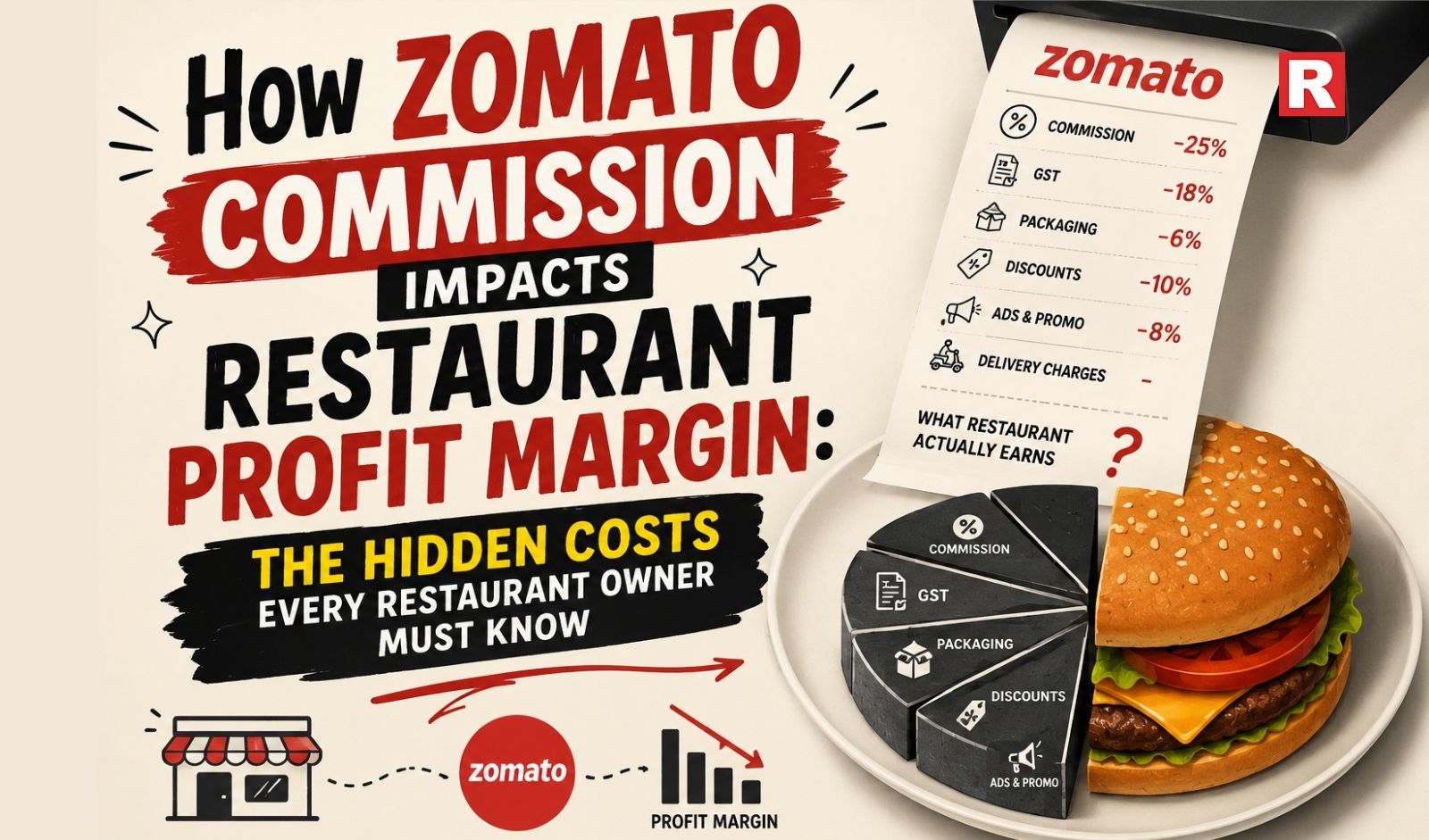
At first glance, the restaurant may assume it earns the full Rs 500. However, the actual calculation is very different. A commission of around 25 percent immediately reduces the revenue. GST on the commission further adds to the deduction. If the restaurant participates in promotional discounts or sponsored advertisements, the final amount received becomes even lower. Once food preparation costs, packaging expenses, staff salaries, rent, electricity, and other operating expenses are included, the remaining profit may be much smaller than expected. This is why high order volumes do not always translate into high profitability.
The Hidden Costs That Reduce Restaurant Margins
Many restaurant operators focus only on commission rates. However, several additional expenses affect profitability.
GST on Commission: GST is charged on the commission amount paid to the platform. While it may appear small on individual orders, it becomes significant when calculated across hundreds or thousands of monthly orders.
Packaging Costs: Food delivery requires durable packaging to ensure food quality and safety during transit. Premium containers, paper bags, seals, and branding materials increase operational expenses. For restaurants offering beverages or delicate dishes, packaging costs can be even higher.
Promotional Discounts: Customers are attracted to offers and discounts. To remain competitive, many restaurants participate in discount campaigns. While discounts help generate more orders, they can also reduce profit margins if not carefully managed. A restaurant may experience increased sales volume but lower profitability due to excessive discounting.
Sponsored Listings and Advertising: Competition on food delivery platforms is intense. Restaurants often invest in sponsored listings to improve visibility and appear higher in search results.
Advertising can drive more orders, but it adds another expense that affects the overall return on investment.
Why Restaurants Increase Prices on Delivery Platforms
Customers often notice that menu prices on food delivery apps are higher than dine-in prices. This pricing difference is usually a response to platform-related costs. Restaurants adjust menu prices to offset commissions, packaging expenses, advertising costs, and promotional spending. Without these adjustments, maintaining healthy profit margins becomes difficult. For many operators, delivery pricing helps balance the economics of online ordering while ensuring business sustainability.
How Different Restaurant Types Are Affected
The impact of Zomato commissions varies depending on the restaurant model.
Cloud Kitchens: Cloud kitchens are among the most affected businesses because they rely heavily on food delivery platforms. Unlike traditional restaurants, they do not generate revenue from dine-in customers. As a result, platform commissions often represent one of their largest operating expenses. Cloud kitchen operators must carefully manage food costs, menu engineering, and customer acquisition expenses to remain profitable.
Quick Service Restaurants (QSRs): QSR brands typically benefit from high order volumes and standardized operations. Their efficient systems allow them to handle delivery orders more effectively. Larger QSR chains may also have stronger negotiating power when discussing commission rates.
Fine Dining and Premium Restaurants: Premium restaurants often have higher average order values, which can help absorb platform-related costs.
However, they still face challenges related to maintaining food quality during delivery and managing customer expectations outside the dine-in environment.
The Relationship Between Sales and Profitability
One of the biggest misconceptions in the restaurant industry is that more sales automatically mean more profits. In reality, profitability depends on understanding unit economics.
For example, a restaurant may generate Rs 10 lakh in monthly online sales. However, after deducting food costs, commissions, GST, packaging expenses, staff salaries, rent, utilities, and marketing costs, the final profit may be far lower than expected.
Restaurant owners should regularly evaluate contribution margins rather than focusing solely on revenue growth. A business that generates consistent profits from fewer orders is often healthier than one that generates large sales volumes with minimal margins.
Strategies Restaurants Use to Protect Profit Margins
Successful restaurants understand that profitability requires a balanced approach.
Focus on High-Margin Menu Items: Menu engineering helps restaurants identify dishes that generate higher profits. Promoting these items can improve overall profitability without significantly increasing operational complexity.
Increase Average Order Value: Restaurants can encourage customers to spend more through meal combinations, family packs, desserts, beverages, and add-on items. A higher average order value helps offset commission expenses.
Optimize Packaging: Using cost-effective packaging solutions without compromising food quality can improve margins over time. Even small savings per order become significant at scale.
Reduce Dependence on Discounts: While discounts can attract customers, relying on them too heavily may damage profitability. Many successful restaurants focus on quality, customer experience, and loyalty programs rather than constant discounting.
Build Direct Customer Relationships: An increasing number of restaurants are investing in their own websites, mobile ordering systems, and WhatsApp-based ordering channels. Direct orders allow restaurants to retain a larger share of revenue while building stronger customer relationships.
Restaurant Profitability in the Delivery Era
Food delivery is expected to remain a key growth driver for India's restaurant industry. Customers value convenience, variety, and fast service, making delivery platforms an important sales channel. However, restaurant operators are becoming more aware of the importance of balancing growth with profitability. The future is likely to see more restaurants adopting hybrid models that combine dine-in, takeaway, direct ordering, and third-party delivery platforms. Technology, customer data, and operational efficiency will play increasingly important roles in protecting margins. Restaurants that understand their costs and make data-driven decisions will be better positioned to succeed in an increasingly competitive market.
Final Thought!
Zomato has created tremendous opportunities for restaurants to reach new customers and expand their businesses. However, commissions are only one part of the cost structure associated with online food delivery. GST, packaging, discounts, advertising expenses, and operational costs all contribute to reducing profit margins. Without proper financial planning, restaurants may experience growing sales but limited profitability. For restaurant owners, the key is not simply generating more orders but understanding the true economics behind each transaction. By optimizing menus, increasing average order values, controlling costs, and building direct customer relationships, restaurants can enjoy the benefits of food delivery platforms while maintaining healthy and sustainable profit margins.
Saptopriya Ghosal
Feature Writer
I am a dedicated media professional with a bachelor's degree in mass communication from the State University of Calcutta and a postgraduate degree from Amity University. My academic journey has equipped me with a profound understanding of storytelling and communication. Passionate about the dynamic world of media, I continually strive to explore new ways to engage and inform through compelling narratives.



































































