
How to Get A Government Loan for Your Restaurant Business
Understanding the world of government loans can be difficult due to their complex processes and eligibility requirements. This article is specifically intended for interested and existing restaurant operators in India.

Many people dream of owning and running a profitable restaurant in India. However, the initial investment required to start or expand a food business can be an important barrier. You see, opening and managing a restaurant requires a huge amount of investment. Fortunately, the Indian government provides a range of loan schemes and initiatives to help small and medium-sized businesses (SMEs), including restaurants.
Understanding the world of government loans can be difficult due to their complex processes and eligibility requirements. This article is specifically intended for interested and existing restaurant operators in India. We'll go over the most important government loan programs, explain the qualifying requirements, walk you through the application process, and give you valuable advice to improve your chances of getting the money you need to pursue your restaurant's dreams.
Read more: Picante Cocktail Recipe: The Spicy-Sweet Drink Taking Over Cocktail Menus
Why Government Loans are Crucial for Indian Restaurants
The food service sector in India is an important contributor to the economy, and the government acknowledges the need to promote its growth. Government loans provide various benefits to restaurant businesses:
- Lower Interest Rates: Government-backed schemes frequently offer lower interest rates than typical bank loans or private lenders, lowering the overall cost of borrowing. This is good for small restaurant owners.
- Easier Collateral Requirements: Some government schemes have simpler collateral requirements, making them more accessible to businesses with few financial assets.
- Focus on Certain Sectors: Many plans are designed to help certain sectors, such as SMEs (small and Medium Enterprises), the food processing industry, which directly benefits restaurants.
- Encouraging Business: Government loan efforts aim to promote entrepreneurship and generate job possibilities in the country, which nicely aligns with the interests of restaurant owners. After all, a single restaurant can provide employment to many people.
Key Government Loan Schemes for Restaurant Businesses in India
Several major government loan schemes can be beneficial for restaurant owners in India. Here are a few of the more relevant options:
1. Pradhan Mantri Mudra Yojana (PMMY)
PMMY is a major plan that aims to give financial assistance to non-corporate, non-farm small and micro enterprises. PMMY loans are grouped into three types:
- Shishu (up to ₹50,000) is ideal for launching a small restaurant or food stand.
- Kishore (₹50,001 to ₹5 lakh) is ideal for established small restaurants seeking to grow or upgrade equipment.
- Tarun (₹5 lakh to ₹10 lakh) is ideal for established restaurants seeking considerable expansion or remodeling.
- Tarun Plus (₹10 lakh to ₹20 lakh) is ideal for opening new restaurants.
Eligibility criteria: Indian citizens with a credible business proposal. Existing and new restaurants are eligible. Loans of up to ₹10 lakh under PMMY often do not require collateral.
How to Apply: You can apply to any Scheduled Commercial Bank, Regional Rural Bank (RRB), Small Finance Bank (SFB), Micro Finance Institution (MFI), or Non-Banking Financial Company (NBFC) that participates in the Mudra Yojana. You must submit an application form, a business plan, KYC documents, and other essential financial information.
Know more: How to Grow Your Restaurant Into A Franchise
2. Credit Guarantee Fund Trust for Micro and Small Enterprises (CGTMSE)
The CGTMSE provides assurances to banks and financial organizations for loans made to qualifying micro and small businesses, including restaurants. This decreases lenders' risk and encourages them to issue loans without strict collateral requirements.
Eligibility criteria: New or existing micro and small enterprises (as defined by the MSMED Act of 2006). Restaurants are often eligible for the service sector category. The CGTMSE scheme covers loans up to ₹2 crore.
How to Apply: You cannot apply directly to the CGTMSE. You must contact a CGTMSE-approved bank or financial institution. The lender will review your loan application and, if approved, secure CGTMSE guarantee cover.
3. Pradhan Mantri Employment Generation Programme (PMEGP)
PMEGP is a credit-linked subsidy program designed to provide job opportunities by aiding entrepreneurs in establishing new micro-enterprises. It is managed by the Ministry of Micro, Small, and Medium Enterprises (MoMSME).
Eligibility criteria: Individuals over the age of 18, Self Help Groups (SHGs), Registered Trusts, Educational Institutions, etc. Setting up a manufacturing unit costs ₹50 lakh, whereas a service sector unit (including restaurants) costs ₹20 lakh. The subsidy component varies depending on the beneficiary's category and the location of the unit (urban or rural).
How to apply: Prepare a project report and apply online through the Khadi and Village Industries Commission's PMEGP portal. Your application will be sent to the administering agency (KVIC/KVIB/DIC) in your district. After examination, you may be invited to an interview before the bank approves the loan.
4. National Small Industries Corporation (NSIC) Schemes
NSIC provides a variety of schemes to help the growth of small and medium-sized enterprises, including financial aid. Their programs frequently focus on technology upgrades, marketing assistance, and credit assistance.
Eligibility criteria: Micro, small, and medium-sized businesses, both existing and new. Restaurants wishing to modernize their culinary equipment or expand their facilities may find NSIC schemes useful.
How to Apply: To learn about individual schemes and the application process, go to the NSIC website or contact a branch in your area. In most cases, you must produce a complete project report as well as financial documents.
What's new: How to Shield Your Restaurant Business from Failing
5. Stand-Up India Scheme
The Stand-Up India Scheme is designed to encourage entrepreneurship among women, Scheduled Caste (SC), and Scheduled Tribe (ST) businesspeople. The scheme offers bank loans ranging from ₹10 lakh to ₹1 crore to at least one Scheduled Caste or Scheduled Tribe borrower and one woman borrower per bank branch for starting a greenfield firm (new venture).
Eligibility criteria: Entrepreneurs over the age of 18 who are women or SC/ST. The company should operate in the manufacturing, service, or trading sectors. Restaurants come under the service sector.
How to Apply: You can apply online through the Stand-Up India portal or go directly to a bank branch. The scheme also offers handholding assistance and credit guarantees through the Credit Guarantee Fund for Stand-Up India (CGFSI).
The Application Process: A Step-by-Step Guide for Restaurateurs
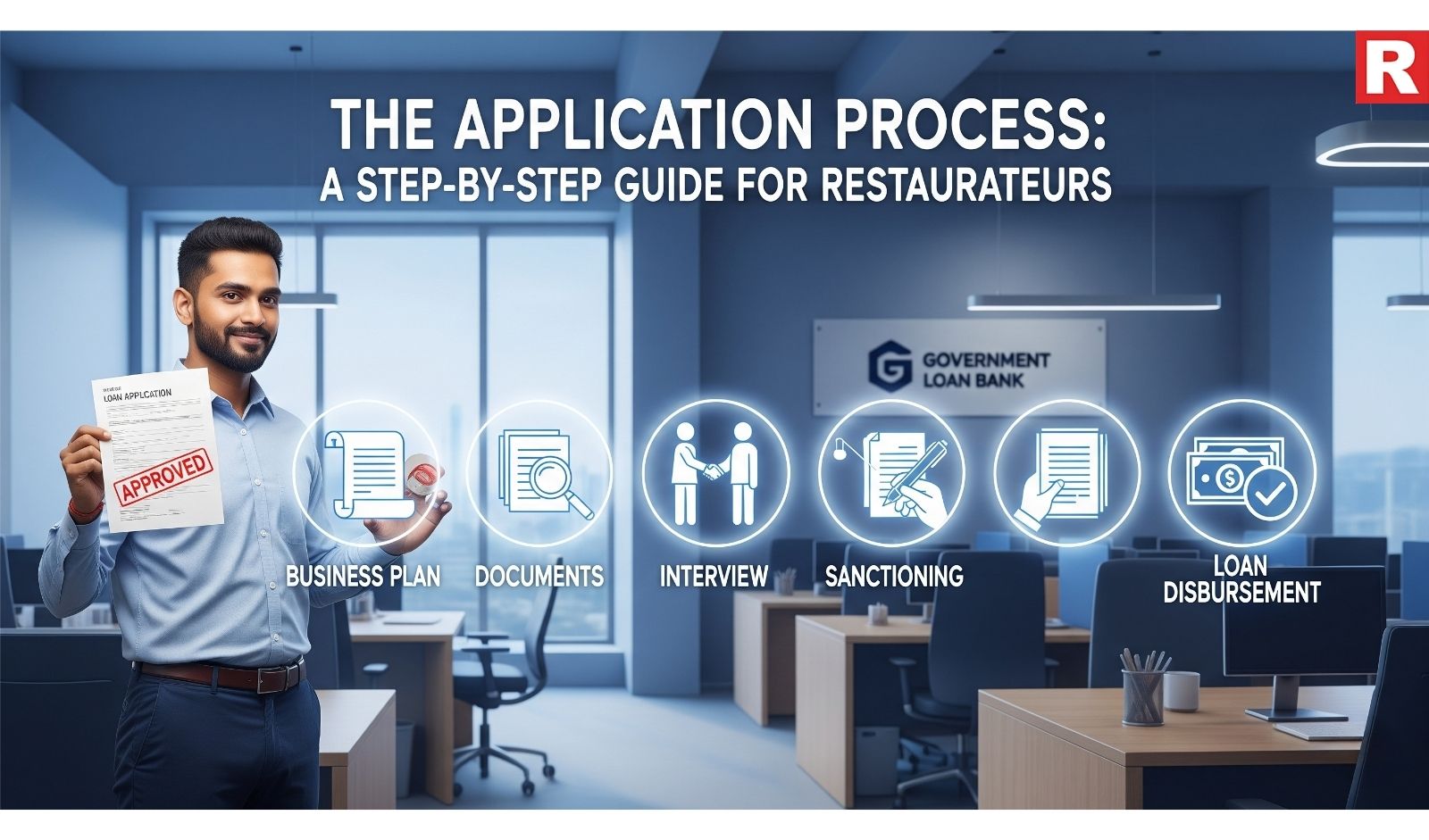
While the requirements may differ based on the plan and the lending group, here is an overall overview of the application process:
- Research and Select the Right Scheme: Carefully consider the eligibility criteria, loan amount, interest rates, and other parameters of several government programs to determine which one is most suited to your restaurant's needs and stage of development.
- Prepare a Comprehensive Business Tactic: A well-written business plan is essential. It should include information about your restaurant concept, target market, marketing strategy, operational plan, budget estimations (including revenue forecasts, cost analysis, and profitability), and the loan amount needed for the intended use.
- Gather the necessary documents: Prepare all necessary documentation, which usually includes:
- Application form (provided by the lending institution or online site)
- KYC paperwork (identification and address proof) for the applicant(s) and promoters
- Business registration evidence (if applicable)
- Partnership agreement or Memorandum and Articles of Association (if necessary)
- Business plans and project reports
- Financial statements (for an existing firm)
- Bank Statements
- Quotation for machinery or equipment (if appropriate)
- Caste certificate (if applying for schemes such as Stand-Up India)
4. Approach the lending institution: Visit the bank, NBFC, or government body that manages the scheme you've chosen. Please submit your application form and all supporting papers.
5. Scrutiny and Due Diligence: The financing institution will assess your application and perform thorough research, which may include site visits and verification of your documents and business plan.
6. Interview and Authorizing: You may be called for an interview to go over the business's strategy and financial projections. If the lender is satisfied, your loan will be approved. So keep yourself prepared for the interview process. You should know every minute detail of your business plan.
7. Payment: Once the loan is approved, funds will be transferred to your bank account following the scheme's terms and conditions.
Check out: Using Gaming to Boost Your Restaurant Business: How does it work?
Tips for Increasing Your Chances of Securing a Government Loan
- Have a Well-Structured Business Plan: A detailed and realistic business plan demonstrating your restaurant's long-term viability and profitability is essential.
- Maintain a Good Credit History: A good credit score boosts your reputation and improves your chances of loan acceptance.
- Offer Accurate Financial Information: Ensure that all financial information you offer is accurate and transparent.
- Highlight Your Restaurant's Unique Selling Point: Clearly define what distinguishes your restaurant and why it is likely to flourish in the market.
- Be prepared to answer questions: Prepare to address all questions from the lending institution concerning your business plan, financial projections, and management team.
- Follow Up Regularly: Stay in touch with the lending institution to monitor the status of your application.
Read this: Top 10 Essential Technology Systems for any Restaurant
Conclusion
A government loan can give the financial encouragement you need to start, expand, or modernize your restaurant business. Understanding the many programs available, carefully completing your application, and following the necessary processes will considerably boost your chances of receiving this vital financial assistance. With the appropriate capital and a good business strategy, you can serve up success and turn your culinary dreams into a tasty reality. Remember to stay up-to-date on the newest government efforts and seek advice from financial specialists to efficiently manage the process.
Mahak Sharma
Content Writer
Mahak Sharma is a passionate content writer with 2 years of experience crafting compelling content across various niches, tailoring her writing to suit different audiences and platforms. She is dedicated to producing engaging content for readers so that they can understand and enjoy the articles. Her strengths lie in crafting SEO-friendly, well-structured articles that drive visibility and engagement.



































































