
How Restaurants Can Rank on Google’s SGE & AI Overviews (2026 Guide)
Google’s AI does not simply rank pages; it selects reliable sources to build its answers. The shift is fundamental—from focusing on rankings to ensuring your restaurant is credible, clear, and relevant enough to be recommended.

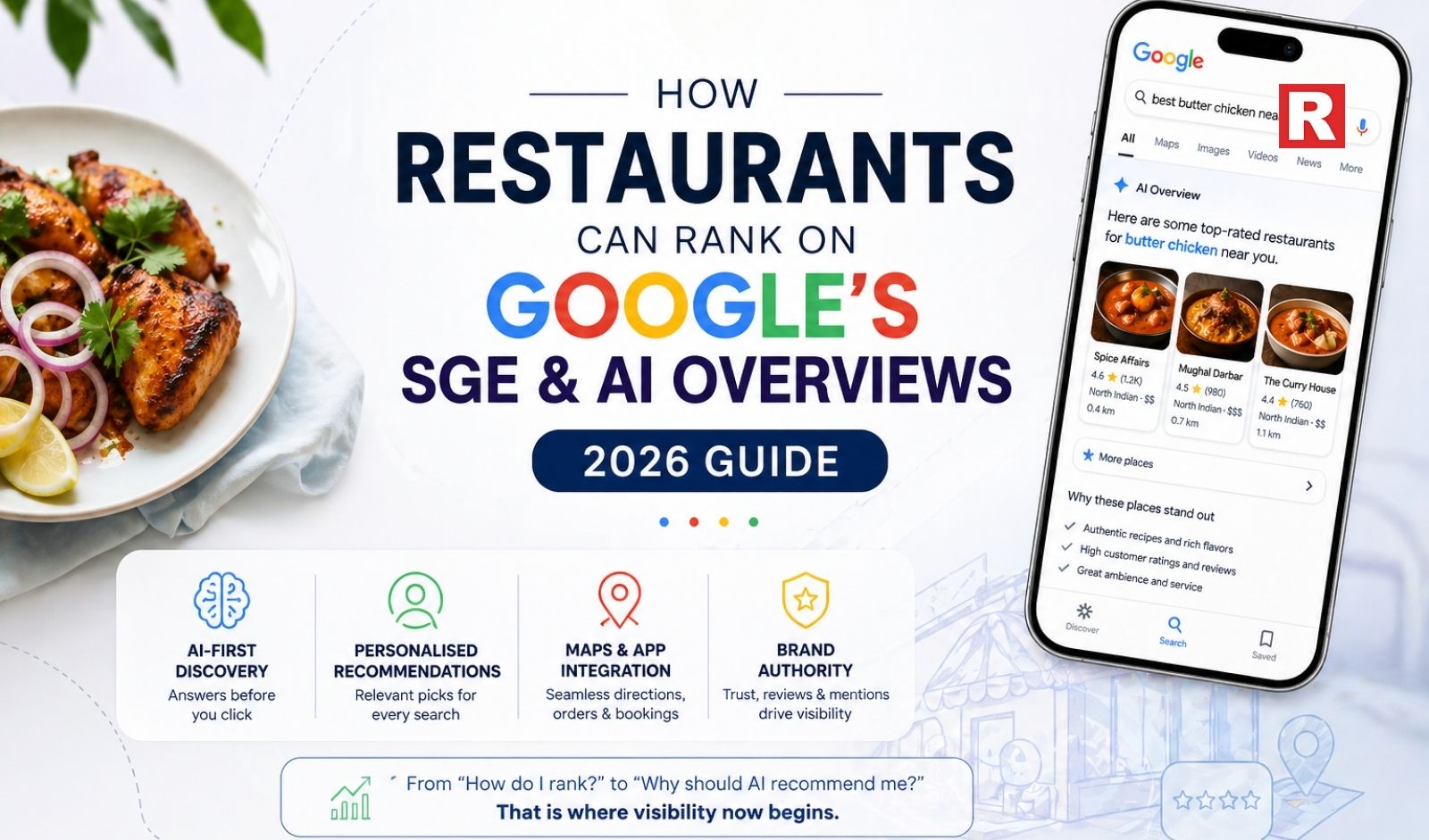
Search is no longer a list of links. It is now a system of answers. When someone searches “best cafés in Delhi” or “late-night food near me,” Google does not just show websites. It generates a complete answer using AI. This layer is called AI Overviews, previously known as SGE. These summaries sit at the top of the page and often reduce the need to click further.
For restaurants, this shift is massive. Discovery is no longer about ranking first. It is about being selected as a trusted source inside the AI answer itself.
The Big Shift: From Rankings to AI Visibility
Google’s AI Overviews summarize information from multiple sources. They combine reviews, menus, images, and website content into one response. This has changed user behaviour in two clear ways:
- People get answers instantly without visiting websites
- Searches are longer and more conversational
- Click-through rates are declining sharply
Studies show that AI Overviews can reduce organic clicks significantly, while increasing impressions and visibility. For restaurants, this means one thing, being visible inside the AI answer matters more than being ranked on page one.
How AI Overviews Work for Restaurant Searches
Let’s take a simple example.
A user searches: “Best butter chicken near me.”
Earlier, Google would show a list of blue links along with a map pack. Users had to click through multiple websites or apps to compare options. Today, with AI Overviews, the experience is very different. Google now generates a structured summary at the top of the page. This summary pulls information from multiple sources such as restaurant websites, Google Business Profiles, reviews, and third-party platforms. Instead of just listing options, it presents a curated answer.
This typically includes:
- A short list of recommended restaurants based on relevance, proximity, and ratings
- Key highlights like signature dishes, pricing range, and cuisine style
- Snippets from customer reviews mentioning taste, quality, or service
- Photos of dishes and interiors to give visual context
- Map integration showing exact locations and distance
In many cases, users get enough information within this AI-generated section to make a decision immediately. They may tap on directions, call the restaurant, or place an order through integrated platforms—without ever visiting a website. This behaviour is known as zero-click search, where the user’s query is answered directly on the results page. According to multiple industry studies, a significant share of Google searches now end without a click, especially for local and intent-driven queries like food and dining. This changes the funnel completely. Discovery, comparison, and decision-making are happening in one place—before a user even considers clicking through. Visibility inside these AI summaries is becoming as important as traditional rankings.
Why Many Restaurants Are Losing Visibility
Many restaurants still rely on old SEO tactics. That is where the gap begins.
Here are the common issues:
- Outdated or incomplete Google Business profiles
- Weak or generic website content
- No structured data or schema markup
- Poor review management
- Lack of clear brand positioning
AI systems do not just scan keywords. They evaluate clarity, trust, and usefulness. If your restaurant is not clearly described online, AI cannot recommend it. This is also why more brands are starting to track their AI visibility regularly — to see whether their business is actually being mentioned inside AI Overviews and AI-generated answers, instead of guessing.
What Google’s AI Actually Prioritises in 2026
1. Clarity and Structured Information
AI systems prioritise content that is easy to scan, interpret, and extract. Unlike traditional search, where keywords played a larger role, AI Overviews rely heavily on how clearly information is presented and organised.
Websites that perform well typically follow a clean and logical structure. This includes:
- Clear headings that define each section (e.g., menu, location, timings)
- Short paragraphs that focus on one idea at a time
- Well-defined menus with item names, descriptions, and pricing
- Direct answers to common user queries such as “Do you offer takeaway?” or “What are your opening hours?”
This format helps AI quickly identify relevant information and use it in generated summaries. For example, if a menu page clearly lists “Butter Chicken – ₹450 – Signature Dish,” it becomes easier for AI to extract and highlight that detail. Structured data (like schema markup) further improves this process by giving search engines explicit signals about your content. When your website is organised and consistent, it increases the chances of being cited in AI-generated answers, especially for local and intent-driven searches.
2. Strong Brand and Trust Signals
AI Overviews prioritise businesses that appear credible, consistent, and widely recognised across the web. Unlike traditional SEO, where a single well-optimised page could rank, AI systems evaluate your overall digital footprint before selecting you as a source.
This includes:
- Consistent business information across platforms like Google Business Profile, delivery apps, and your website (same name, address, phone number, and category)
- Positive and recent reviews, especially those that mention specific dishes, service quality, or ambience
- Mentions across third-party websites, such as food blogs, local media, and listings
AI models aggregate signals from multiple sources to verify authenticity. If your restaurant appears reliable and frequently referenced, it increases your chances of being included in AI-generated summaries. Recent search trends indicate a clear brand bias, where known and trusted names are more likely to be surfaced. For restaurants, this means reputation is no longer just about perception—it directly impacts visibility. In simple terms, the stronger and more consistent your presence across platforms, the more likely AI is to recommend you.
3. Entity-Based SEO
Google is moving beyond keywords and focusing on “entities.” An entity is a clearly defined business with specific attributes that help search engines understand exactly what it is.
For restaurants, this means Google looks at:
- Who you are (your brand name and identity)
- What you offer (cuisine, signature dishes, price range)
- Where you are located (area, neighbourhood, city)
- What makes you unique (specialties, dining experience, chef style)
Instead of relying on generic phrases like “best restaurant in Delhi,” AI systems respond better to precise descriptions. For example, “Modern North Indian restaurant in South Delhi known for slow-cooked gravies and seasonal menus.” This level of detail helps Google connect your restaurant to specific search intents, such as “authentic North Indian food in South Delhi” or “premium dining with traditional recipes.” Entity-based SEO also relies on consistency across platforms. Your website, Google Business Profile, and listings should all describe your restaurant in the same way. This builds a clear identity that AI can recognise, trust, and recommend in relevant searches.
4. Reviews as a Ranking Engine
Reviews are no longer just about influencing customers. They are a critical data source for AI-driven search. Google’s systems analyse reviews at scale to understand what a restaurant is known for. This goes beyond star ratings. AI evaluates:
- Keywords and phrases used by customers (e.g., “best brunch,” “late-night dining,” “family-friendly”)
- Sentiment, or how positive or negative the feedback is
- Frequency and recency, meaning how often reviews are posted and how recent they are
For example, if multiple recent reviews mention “great brunch in Khan Market,” Google starts associating that restaurant with brunch searches in that location. Detailed reviews with specific dish names or experiences carry more weight than generic ones. A review mentioning “butter chicken was rich and well-balanced” provides stronger context than simply saying “good food.” Consistency also matters. A steady flow of authentic reviews signals that the business is active and reliable. In 2026, reviews directly influence how AI categorises and recommends restaurants, making them one of the strongest drivers of local visibility.
5. Multimodal Content (Images + Videos)
Search is no longer limited to text. Google’s AI systems now process and combine multiple formats—text, images, and videos—to understand and present results more effectively.
AI Overviews increasingly rely on:
- Food photos that showcase presentation, portion size, and variety
- Interior and ambience images that reflect the dining experience
- Short videos such as kitchen prep, plating, or customer moments
- Social content from platforms like Instagram, especially geo-tagged posts
These visual signals help Google interpret quality, popularity, and context. For example, clear images of a signature dish can reinforce its relevance for searches like “best butter chicken near me.” Similarly, consistent interior visuals help position a restaurant as casual, premium, or family-friendly. Google also prioritises fresh and authentic visuals. Regularly updated photos on your Google Business Profile and website signal that the business is active and reliable. In 2026, strong visual content is not optional. It directly supports how AI evaluates and presents your restaurant, giving those with high-quality, consistent imagery a clear advantage in search visibility.
Local SEO Still Matters—But It Has Evolved
Local SEO is not dead. It has expanded. Earlier, the goal was to rank in the Google Maps 3-pack. Now, the goal is to appear in AI-generated summaries.
This includes:
- Optimised Google Business Profile
- Location-specific pages
- Consistent NAP (Name, Address, Phone)
Restaurants that align local SEO with AI signals see higher engagement, including more direction requests and bookings.
Optimising for Conversational and Voice Search
Search queries are changing.
Users now ask:
- “Where can I get late-night food in Delhi?”
- “Affordable sushi places near me with delivery”
These are natural language queries.
To match this:
- Write content like people speak
- Add FAQ-style sections
- Use long-tail keywords naturally
AI systems prioritise intent over exact keywords.
Content Strategy That Works in AI Search
Content is still critical. But the format has changed.
Winning restaurants create:
- Local guides (e.g., “Best brunch spots in South Delhi”)
- Cuisine-focused blogs (e.g., “Why ramen is trending in India”)
- Menu-driven landing pages
- Seasonal or trend-based content
The key is simple: Answer real customer questions clearly. AI pulls content that is useful, not just optimized.
Zero-Click Search: Threat or Opportunity?
At first glance, fewer clicks seem like a loss. But for restaurants, it is not.
Even without clicks, AI visibility drives:
- Calls
- Directions
- Walk-ins
- Orders
AI compresses the decision journey. Users arrive ready to act. The value is no longer traffic. It is conversion.
Common Mistakes Restaurants Must Avoid
- Treating SEO as a one-time task
- Ignoring Google Business updates
- Using generic descriptions
- Not responding to reviews
- Having outdated menus online
- Slow or broken websites
In AI search, inconsistency reduces trust. Many restaurants today choose to work with an AI digital marketing agency to fix these gaps systematically — aligning their website content, schema, reviews, and brand signals so AI systems can clearly recognise and recommend them.
Final Takeaway
Search is rapidly evolving into an AI-first experience where discovery happens through generated answers rather than traditional listings. Google is increasingly delivering personalised recommendations based on user behaviour, location, and preferences, while deeply integrating results with maps, reviews, and even ordering platforms. At the same time, there is a growing reliance on brand authority, where well-established and consistently represented restaurants are more likely to be surfaced. Industry trends already show that users are beginning to explore options through AI-driven tools and summaries before engaging with standard search results, and this behaviour is expected to grow further.
In this environment, success is no longer about basic optimisation. Restaurants that perform well are those that are clearly understood by AI systems. This means having a well-defined identity, a strong and active reputation through reviews, consistent information across all platforms, and structured content that is easy for both users and machines to interpret. Google’s AI does not simply rank pages; it selects reliable sources to build its answers. The shift is fundamental—from focusing on rankings to ensuring your restaurant is credible, clear, and relevant enough to be recommended.
Saptopriya Ghosal
Feature Writer
I am a dedicated media professional with a bachelor's degree in mass communication from the State University of Calcutta and a postgraduate degree from Amity University. My academic journey has equipped me with a profound understanding of storytelling and communication. Passionate about the dynamic world of media, I continually strive to explore new ways to engage and inform through compelling narratives.



































































