
How Cloud Kitchens Work: End-to-End Operations Explained
As online food ordering continues to grow, understanding these operations will be essential for restaurant owners, entrepreneurs, and investors looking to succeed in the future of dining.

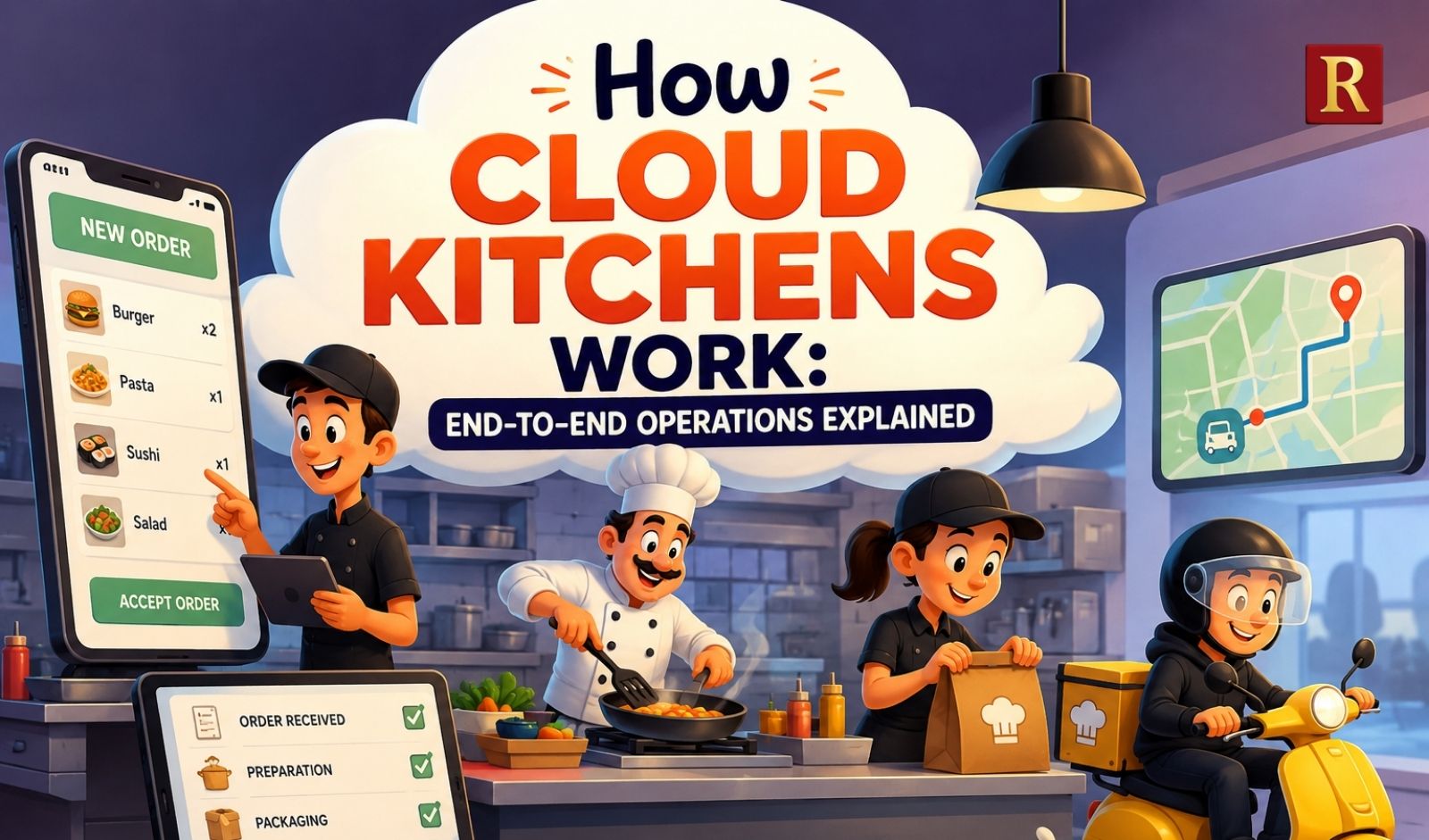
The way people order food has changed dramatically over the last few years. A growing number of consumers now prefer ordering meals through mobile apps instead of visiting restaurants. This shift has given rise to one of the fastest-growing business models in the food industry: cloud kitchens.
Unlike traditional restaurants, cloud kitchens operate without dining areas, waitstaff, or expensive storefronts. They focus entirely on preparing food for delivery. While customers only see the final meal arriving at their doorstep, a complex system of technology, logistics, and kitchen management works behind the scenes to make every order successful. Understanding how cloud kitchens operate reveals why they have become such a powerful force in modern food service.
What Is a Cloud Kitchen?
A cloud kitchen is a delivery-only food business that prepares meals exclusively for online orders. Customers place orders through food delivery apps, websites, or mobile applications, and the food is prepared in a centralized kitchen facility. Cloud kitchens are also known as ghost kitchens, dark kitchens, or virtual kitchens. Since they do not serve dine-in customers, operators can save significantly on rent, interiors, and front-of-house staff. This model allows businesses to focus on food quality, speed, and operational efficiency rather than customer-facing experiences.
Why Cloud Kitchens Are Growing Rapidly
The growth of food delivery platforms has changed consumer expectations. People now want convenience, faster delivery, and access to a wide range of cuisines without leaving their homes.
Several factors have contributed to the rise of cloud kitchens:
- Increased smartphone usage
- Expansion of food delivery platforms
- Busy urban lifestyles
- Demand for convenience
- Lower business setup costs
- Growing acceptance of online ordering
For entrepreneurs, cloud kitchens offer a faster and more affordable way to enter the food business compared to opening a traditional restaurant.
Step 1: Customer Places an Order
Every cloud kitchen operation begins when a customer places an order.
This can happen through:
- Food delivery apps
- Restaurant websites
- Mobile applications
- Social media channels
- WhatsApp ordering systems
- ONDC-enabled platforms
Once an order is confirmed, the information is instantly transmitted to the kitchen's management system. Modern cloud kitchens rely heavily on software integrations that ensure orders are received without delays or manual intervention. This automation reduces mistakes and improves customer satisfaction.
Step 2: Order Aggregation and Centralized Management
One of the biggest challenges for food businesses is managing orders coming from multiple sources. Imagine receiving orders simultaneously from different delivery apps, a website, and a mobile app. Handling each platform separately can create confusion and operational errors. To solve this, cloud kitchens use order aggregation systems. These systems collect orders from multiple channels and display them on a single dashboard. Staff members can view, accept, and process all incoming orders from one place.
This centralization helps operators:
- Reduce missed orders
- Improve efficiency
- Minimize manual work
- Track performance in real time
For large cloud kitchen brands, order aggregation acts as the command center of daily operations.
Step 3: Intelligent Kitchen Routing
Once an order enters the system, it is automatically routed to the appropriate kitchen station. For example, a cloud kitchen may operate multiple virtual brands from a single facility. One brand may specialize in burgers, another in biryani, and another in desserts. The software identifies the items ordered and directs them to the correct preparation team. The ability to run multiple brands under one roof is one of the biggest advantages of the cloud kitchen model.
This process helps:
- Speed up food preparation
- Avoid kitchen congestion
- Improve workflow management
- Maintain delivery timelines
Step 4: Kitchen Display Systems Keep Operations Moving
Traditional restaurants often rely on printed tickets. Cloud kitchens use digital kitchen display systems instead. These screens show incoming orders, preparation status, cooking times, and delivery deadlines. Kitchen display systems help chefs prioritize tasks and coordinate production efficiently.
The benefits include:
- Faster communication
- Reduced paper usage
- Better order accuracy
- Real-time production tracking
During peak meal hours, these systems play a critical role in maintaining smooth operations.
Step 5: Inventory Management Behind the Scenes
Inventory management is one of the most important aspects of cloud kitchen success. Every order directly affects ingredient availability. For example, when a customer orders paneer tikka, naan, and dal makhani, the system automatically deducts the required ingredients from inventory records.
Modern inventory software helps operators:
- Monitor stock levels
- Track ingredient usage
- Reduce food wastage
- Forecast future demand
- Generate purchase orders
Without proper inventory control, cloud kitchens can face stock shortages, increased costs, and inconsistent customer experiences.
Step 6: Food Preparation and Quality Control
Food preparation is where operational excellence becomes visible to customers. Since customers never visit the kitchen, food quality becomes the primary factor influencing reviews and repeat purchases. Successful cloud kitchens follow strict standard operating procedures.
These include:
- Standardized recipes
- Portion control guidelines
- Cooking consistency measures
- Hygiene protocols
- Food safety standards
Consistency is especially important because customers expect the same taste and quality every time they order. A single negative experience can affect ratings and future sales.
Step 7: Packaging Matters More Than Ever
Packaging is often overlooked, but it plays a major role in customer satisfaction. A perfectly cooked meal can still disappoint customers if it arrives cold, damaged, or leaking. Cloud kitchens invest heavily in packaging solutions designed to protect food during transportation.
Key packaging priorities include:
- Temperature retention
- Leak prevention
- Tamper-proof sealing
- Sustainability
- Brand visibility
Good packaging improves customer trust and enhances the overall dining experience.
Step 8: Delivery Dispatch and Rider Coordination
Once the food is prepared and packed, the delivery process begins. The kitchen management system notifies delivery partners that an order is ready for pickup. Modern cloud kitchens use technology to coordinate dispatch operations efficiently.
These systems provide:
- Rider assignment
- Pickup scheduling
- GPS tracking
- Route optimization
- Estimated delivery times
Efficient dispatch management helps ensure that food reaches customers quickly while maintaining quality. Delivery speed has become one of the most important competitive advantages in the industry.
Step 9: Customer Feedback and Continuous Improvement
The journey does not end when the order is delivered. Customer feedback provides valuable insights that help cloud kitchens improve their operations.
Reviews and ratings allow businesses to understand:
- Food quality issues
- Delivery performance
- Packaging effectiveness
- Popular menu items
- Customer preferences
Successful operators closely monitor feedback and use data to make informed business decisions. This continuous improvement cycle helps drive customer retention and long-term growth.
The Technology Stack Powering Modern Cloud Kitchens
Technology forms the backbone of cloud kitchen operations. A typical cloud kitchen relies on multiple systems working together.
These include:
- Point-of-sale software
- Order aggregation platforms
- Kitchen display systems
- Inventory management software
- Customer relationship management tools
- Delivery management solutions
- Analytics dashboards
Increasingly, operators are also using artificial intelligence to forecast demand, optimize menus, and improve operational efficiency. In many ways, cloud kitchens function as technology-driven food businesses rather than traditional restaurants.
How One Kitchen Can Run Multiple Brands
One of the most innovative aspects of cloud kitchens is the multi-brand model. A single facility can prepare food for several virtual restaurant brands simultaneously.
For example, one kitchen may operate:
- A pizza brand
- A biryani brand
- A healthy bowl brand
- A dessert brand
Because equipment, staff, and infrastructure are shared, operators can maximize efficiency while serving different customer segments. This flexibility allows businesses to test new concepts quickly and scale successful brands faster.
The Future!
Cloud kitchens are rapidly evolving as technology becomes a bigger part of food service operations. Innovations such as AI-powered demand forecasting are helping operators predict customer demand more accurately, reducing food waste and improving inventory planning. Smart kitchen automation and robotics-assisted cooking are also beginning to streamline food preparation, allowing kitchens to increase efficiency while maintaining consistency. At the same time, many brands are investing in direct-to-consumer ordering channels to reduce dependence on third-party delivery platforms and build stronger customer relationships. Hyperlocal delivery networks are further improving delivery speed, helping businesses meet growing consumer expectations for convenience. Advanced data analytics is also playing a key role, enabling operators to make better decisions about menus, pricing, and operations. Cloud kitchens have already transformed the food delivery industry by combining culinary expertise with technology and logistics. Every order passes through a carefully managed process involving order aggregation, food preparation, inventory tracking, packaging, dispatch, and customer feedback. Unlike traditional restaurants that focus heavily on ambience and in-person service, cloud kitchens are built around efficiency, scalability, and data-driven decision-making. As online food ordering continues to grow, understanding these operations will be essential for restaurant owners, entrepreneurs, and investors looking to succeed in the future of dining.
Saptopriya Ghosal
Feature Writer
I am a dedicated media professional with a bachelor's degree in mass communication from the State University of Calcutta and a postgraduate degree from Amity University. My academic journey has equipped me with a profound understanding of storytelling and communication. Passionate about the dynamic world of media, I continually strive to explore new ways to engage and inform through compelling narratives.



































































