
GST Rules for Cloud Kitchen Business in India: What Really Affects Your Margins (2026 Guide)
Cloud kitchens in India already operate on tight margins. Once you factor in platform commissions, delivery costs, and GST-related inefficiencies, the pressure becomes even higher.

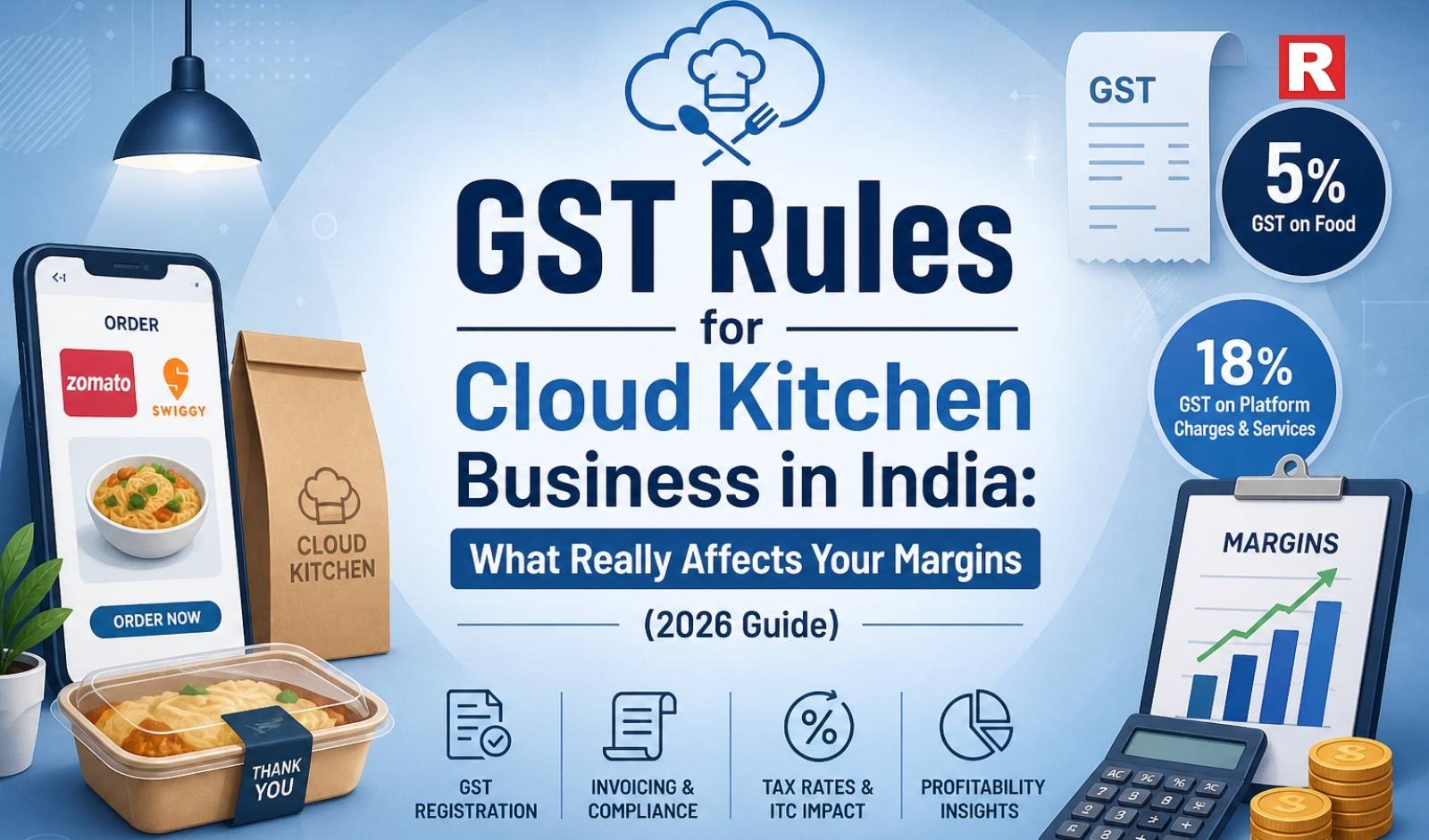
Running a cloud kitchen in India often begins with a simple assumption—lower costs, faster setup, and easy scalability. But once operations start, GST quickly becomes one of the most important factors shaping profitability. It is not just a tax you pass on to customers. It directly impacts how much you earn from every order. Most founders realise this only after they see their margins shrinking despite steady sales.
Why GST Feels Complicated in a Simple Business
At first glance, the GST structure for food looks straightforward. Restaurant services are taxed at 5 percent. That sounds manageable. But the challenge begins when you factor in how a cloud kitchen actually operates.
A typical order today comes through platforms like Swiggy or Zomato. Along with food costs, you are also paying commissions, logistics fees, and advertising spends. These services attract 18 percent GST. At the same time, you cannot claim input tax credit on most of your expenses because your output tax is only 5 percent. This gap between 5 percent and 18 percent creates a hidden pressure on margins. It is not visible in pricing, but it shows up in your profits.
How GST Classifies a Cloud Kitchen
Under Indian GST law, a cloud kitchen is treated the same as a restaurant. It falls under “restaurant services,” even if there is no dine-in space. Whether you operate from a commercial kitchen, a takeaway outlet, or even a home setup, the classification remains the same as long as you are supplying cooked food for consumption. This classification decides two critical things—your tax rate and whether you can claim input tax credit.
When You Need to Register for GST
For many small businesses in India, GST registration becomes mandatory only after crossing Rs 20 lakh in annual turnover. But cloud kitchens operate differently, especially if they depend on delivery platforms. If you are selling through Swiggy or Zomato, GST registration becomes compulsory from day one. This applies even if your business is still small and has not reached the usual threshold. The reason is simple. Selling through e-commerce platforms triggers mandatory registration under GST rules. Many first-time founders overlook this and face compliance issues later. GST compliance for cloud kitchens is not complicated, but it requires accuracy.
You need to:
- File GSTR-1 and GSTR-3B regularly
- Report aggregator sales separately
- Match your data with platform reports
- Maintain proper invoices and records
Even though aggregators pay GST, you still need to report those sales correctly.
Understanding the 5 Percent GST Rate
The core of the GST structure for cloud kitchens lies in the 5 percent tax on food. This applies to most orders, whether they are takeaway or delivery. However, this rate comes with a trade-off. You are not allowed to claim input tax credit. That means any GST you pay on raw materials, packaging, rent, or kitchen equipment becomes part of your cost instead of being adjusted. For example, if you are paying GST on packaging or kitchen supplies, you cannot offset it against the tax you collect from customers. Over time, this increases your effective cost of running the business.
What Happens When You Sell Through Swiggy and Zomato
The role of aggregators introduces another layer of complexity. Under Section 9(5) of the GST law, platforms like Swiggy and Zomato are responsible for collecting and depositing GST on your behalf for food delivery orders. In practical terms, this means the customer pays GST, the platform collects it, and the government receives it from the platform. You do not directly pay this tax for those orders.
However, this does not remove your responsibility entirely. You still need to report these sales in your GST filings. These transactions are recorded differently, and accuracy becomes important because the government already has data from the platforms. At the same time, all the services you receive from these platforms—commissions, delivery support, and advertising—are taxed at 18 percent. This cost sits entirely with you.
The Input Tax Credit Problem
Input tax credit is where the real financial impact of GST is felt. In many industries, businesses can claim back the GST they pay on expenses. This helps reduce overall tax liability. In cloud kitchens operating at a 5 percent GST rate, this benefit is not available. Every rupee of GST paid on inputs becomes a direct cost.
If your monthly expenses include packaging, raw materials, rent, and marketing services, the tax paid on these adds up quickly. Over time, this can reduce your margins by a noticeable percentage. Some businesses explore higher GST categories where input tax credit is allowed, but for most cloud kitchens, the standard 5 percent structure remains the default due to pricing sensitivity.
Composition Scheme and Its Limitations
For smaller cloud kitchens, the composition scheme may appear attractive because it simplifies compliance and reduces the complexity of filings. It offers a lower tax burden with minimal paperwork.
However, it comes with clear limitations. Businesses under this scheme cannot claim input tax credit and cannot freely operate across states. There are also restrictions when dealing with online aggregators. Because of these constraints, the composition scheme works best for small, local operations that do not plan to scale aggressively or rely heavily on delivery platforms.
Different Sales Channels, Different GST Impact
Not all sales in a cloud kitchen are treated the same under GST. The way you receive orders changes how tax is applied. If a customer orders directly from your website or calls your kitchen, you are responsible for collecting and paying GST. If the order comes through an aggregator, the platform handles the tax under Section 9(5). If you expand into selling packaged or branded food products, those items may fall under different GST rates, sometimes as high as 18 percent, depending on classification. This makes it important to clearly track each type of revenue. Mixing them up can lead to incorrect filings.
Section 9(5): The Rule That Changes Everything
Section 9(5) is the most important concept for cloud kitchens. It shifts the responsibility of paying GST from the restaurant to the aggregator.
In simple terms:
- Customer pays GST
- Platform collects and deposits it
- You report the sale but do not pay tax on it
This applies only to orders placed through platforms. Direct orders (website, WhatsApp, walk-in takeaway) are still your responsibility.
Another important detail:
- These sales are treated as exempt from your side
- But they still count toward your turnover
Why GST Directly Impacts Your Profitability
Cloud kitchens already operate on thin margins. Typically:
Net margins range between 15–25%
Now add:
- No ITC on major costs
- 18% GST on platform services
- High dependency on aggregators
The result:
- Reduced pricing flexibility
- Lower profit per order
This is why many successful cloud kitchens:
- Focus on direct ordering channels
- Optimise menu pricing with GST in mind
Compliance Is Simple but Not Optional
Even though aggregators handle part of the tax process, compliance is still your responsibility. You need to file regular GST returns, report all sales accurately, and reconcile your numbers with platform data.
Most issues arise not because the rules are difficult, but because the data is not aligned. Platforms maintain detailed transaction records, and any mismatch can trigger notices. Maintaining proper invoices and structured accounting from the beginning avoids these problems.
Where Most Cloud Kitchens Go Wrong
A common mistake is assuming GST is just a backend function handled by an accountant. In reality, it is a business decision that affects pricing and growth strategy. Some founders ignore the impact of 18 percent GST on platform services. Others fail to separate direct orders from aggregator sales. Many underestimate how the lack of input tax credit increases their operating cost. These are not compliance errors alone. They directly reduce profitability.
The Bottom Line
Cloud kitchens in India already operate on tight margins. Once you factor in platform commissions, delivery costs, and GST-related inefficiencies, the pressure becomes even higher. This is why many successful operators are now building a balance between aggregator-driven sales and direct ordering channels. Direct orders give better control over margins, even though they require more effort in marketing and customer acquisition. Pricing decisions are also increasingly being made with GST in mind, rather than treating it as a separate layer.
GST for cloud kitchens is straightforward in structure but complex in its impact. The 5 percent tax rate may look attractive, but the inability to claim input tax credit and the high cost of platform services change the equation. Understanding how these elements interact is what separates a sustainable business from one that struggles with margins. For anyone building or scaling a cloud kitchen in India, GST is not just about compliance. It is a key part of the business model itself.
Saptopriya Ghosal
Feature Writer
I am a dedicated media professional with a bachelor's degree in mass communication from the State University of Calcutta and a postgraduate degree from Amity University. My academic journey has equipped me with a profound understanding of storytelling and communication. Passionate about the dynamic world of media, I continually strive to explore new ways to engage and inform through compelling narratives.



































































