
Designing Desire: The Power of Ambience and Decor in Today’s Dining Landscape
The term “Instagrammable” is often used lightly, but in reality, it’s about creating memorable environments that spark curiosity and storytelling.


In today’s hospitality landscape, ambience and decor are more than just visual enhancements; they are pivotal elements of the overall guest experience. Good decor really makes a difference. It grabs attention, sets the mood, and creates an environment where people want to stay a little longer.
With the power of social media, restaurants and hotels are getting viral on Instagram with reels and photos attracting the young crowds. The term “Instagrammable” is often used lightly, but in reality, it’s about creating memorable environments that spark curiosity and storytelling.
How Ambience defines the Restaurant?
For me, the interiors are like the visual handshake of a restaurant — they tell people who you are before they even taste the food.
Talking about the ambience, Mickee Tuljapurkar, Owner, La Loca Maria and La Panthera said, “At La Panthera, we wanted the space to reflect that blend of timeless yet on-trend European charm. The inspiration came from our travels across Europe, drawing ideas from different countries to create a space that feels both classic and modern. At La Loca Maria, we went for a warm Spanish feel that’s laid-back but still high-end. The murals, textures, and colors all speak to our love for Spanish culture, making our space a reflection of Chef Manuel Olveira’s roots.”

(In pic: La Loca Maria in Mumbai)
Commenting on the same, Samir Shah, Managing Partner, Alexis Hospitality, added, “At Santorini, our rooftop setting with panoramic city views, Mediterranean inspired decor, ambient lighting, and curated soundscapes work together to create a transportive escape for diners. In an era driven by social media and aesthetic storytelling, the visual and emotional appeal of a space can often be the deciding factor for first-time visits and return customers.

(In pic: Santorini)
Challenges Faced by Restaurants
The advantage of a well-designed space lies in its ability to increase dwell time, boost per-cover spends, and generate organic social media buzz through guest photos and check-ins. It also positions the brand as premium and experiential, attributes that resonate strongly with today’s lifestyle driven consumers.
While the benefits are many, creating and maintaining a consistently engaging ambience presents challenges such as weather uncertainties, evolving design trends, and the high cost of maintenance.
“Rooftop venues like ours are also at the mercy of environmental factors like wind and rain. To overcome these, we invest in all-weather furnishings, adaptive lighting, modular decor, and seasonal updates that keep the space fresh without compromising the brand’s core aesthetic,” pointed Shah.
One of the toughest parts is making sure the space looks good but also works well practically. While, adding her views, Mickee said, “We want to fit in enough seats, so people feel like they’re getting a good vibe, but not so crammed that it feels tight. Lighting, sound, and flow are also super important.”
Creativity at Top
Designing a restaurant is about balancing creativity with functionality. It’s easy to get carried away with visual concepts, but the space needs to work seamlessly for staff, customers, and operations.
Talking about the same, Keith Menon, Founder, Spiro Spero who has designed Silly, Blah, Hoppipola, Demy, Que Sera, KAIA, amongst other, pointed, “Some of the biggest challenges involve optimizing limited space, managing acoustics, and ensuring the design aligns with the kitchen workflow. There’s also the emotional aspect—making sure the space resonates with the brand and the community it serves.”
He also mentioned that collaboration is key to building spaces that are both beautiful and practical.
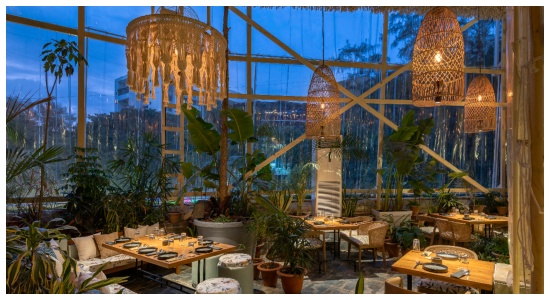
(In Pic: Tuski in Pune designed by Architect Keith Menon)
While Sumessh Menon, Architect & Founder, Sumessh Menon Associates who has recently designed Donmai and Mirage in Mumbai, currently designing Yazu in Colombo and Srilanka feels that Indian restaurant brands are expanding widely in US, UAE and in other places and décor plays a major important role in it.
“We use monochrome colors, ceiling with LED, the way we design floorings has changed, and bar is the major focus everywhere. Every good restaurant has a good outdoor view these days. The main challenge for us is the timelines. The look and feel and execution of a project on a short timeline is one of the biggest challenges,” he explained.

(In Pic: Donmai in Mumbai designed by Sumessh Menon)
And there’s no denying that the right ambience of restaurant can contribute around 40-50% of the business. And the future is shaped by evolving customer expectations, aesthetic, technological integration and sustainability.
Vijetha Iyer
Content Editor
Working as a Content Editor with Restaurant India. I have worked in various sectors like food and beverage sector, chemicals, pharma, nutraceuticals, now specially focusing on restaurant side. But my core knowledge was always on content. Be it writing poems to verses, I always loved writing and have been exploring my career on the same. In Restaurant India, I deliver insightful stories, take interviews of various brands and update the audiences about the newest happenings in the restaurant industry.


