
Cloud Kitchen POS & Technology Stack Explained: The Backbone of India’s Delivery-First Food Business
POS systems, kitchen display software, inventory tools, CRM platforms, analytics dashboards, and aggregator integrations now form the foundation of modern food delivery businesses.

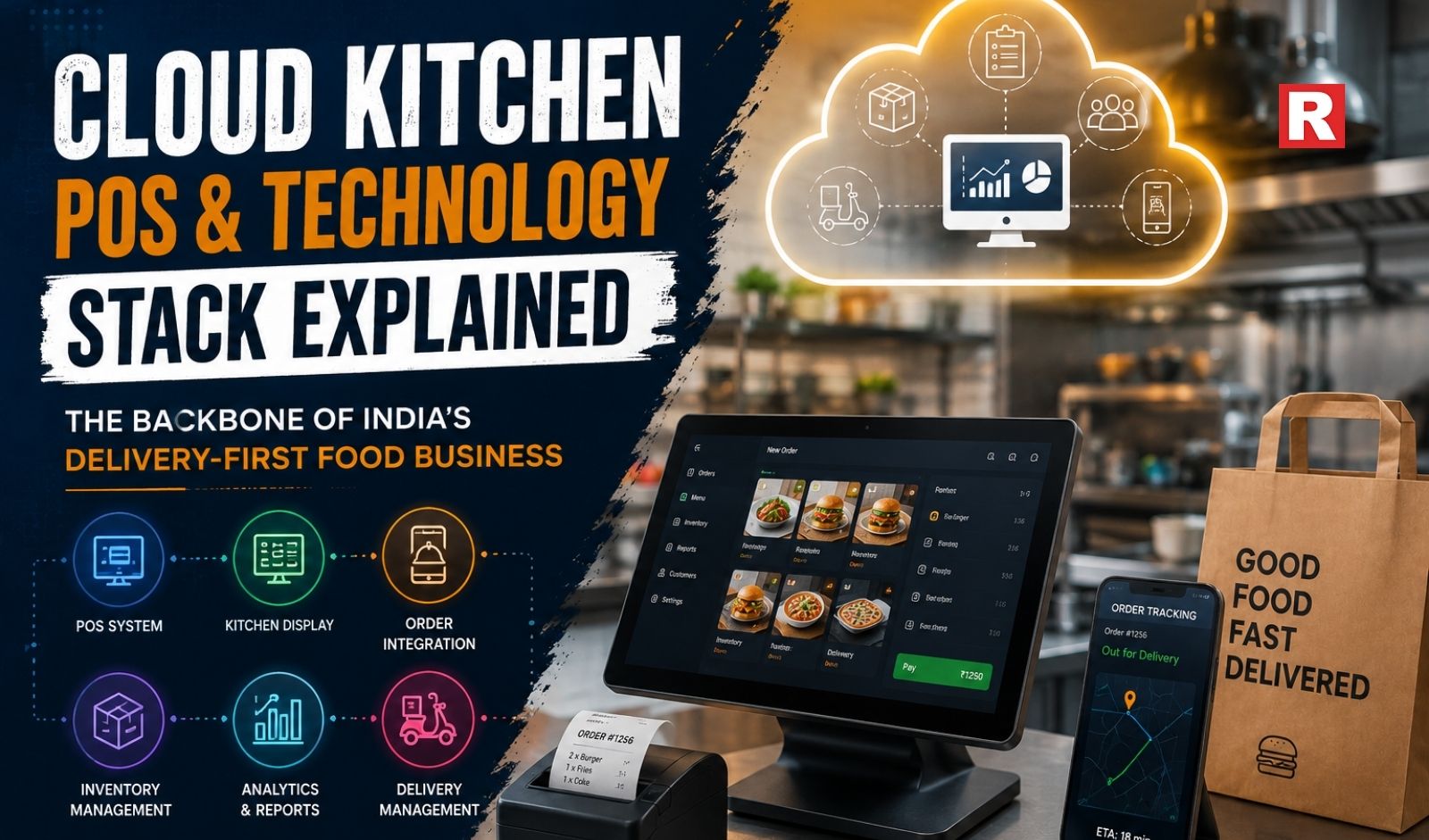
The cloud kitchen business in India has moved far beyond being just a startup trend. It is now one of the fastest-growing parts of the food service industry. From late-night biryani brands and healthy bowl concepts to dessert-only kitchens and celebrity-backed food ventures, delivery-first brands are expanding rapidly across metros as well as Tier-2 cities. According to industry reports, India’s cloud kitchen market is expected to grow strongly over the next decade as online food ordering becomes a part of daily life.
But behind every successful cloud kitchen is something customers never notice directly—technology.
A modern cloud kitchen is not just a cooking space. It is a data-driven operation powered by POS systems, inventory software, kitchen display systems, delivery integrations, analytics dashboards, and automation tools. These technologies help kitchens manage hundreds of online orders without the chaos of traditional restaurant operations.
What Is a Cloud Kitchen POS System?
A POS system, or Point of Sale system, works as the central operating system of a cloud kitchen. Unlike traditional restaurant POS software that mainly handles dine-in billing, table reservations, and waiter coordination, cloud kitchen POS systems are specially built for fast-moving delivery operations. These systems manage online orders from platforms like Swiggy, Zomato, ONDC, and direct websites through one centralized dashboard. They also handle billing, menu updates, kitchen routing, inventory tracking, delivery coordination, sales reports, and multi-brand management in real time. For instance, a single kitchen may operate burger, pizza, and Chinese food brands simultaneously, while the POS automatically sends each order to the correct kitchen station. This improves speed, reduces manual errors, and helps kitchens handle peak-hour order volumes efficiently.
Why Cloud Kitchens Need a Different Technology Stack
Cloud kitchens operate very differently from traditional restaurants. There is no dining area, no customer interaction at the counter, and no physical footfall. Everything depends on speed, coordination, and delivery accuracy. A normal restaurant can survive occasional delays because customers are already inside the outlet. But in cloud kitchens, a delayed order directly affects customer ratings and repeat business. This is why cloud kitchens require a highly connected technology ecosystem.
A modern cloud kitchen usually handles orders from:
- Swiggy
- Zomato
- ONDC
- Brand websites
- Mobile apps
- WhatsApp ordering systems
Without integration software, staff would manually enter every order into the kitchen system. That increases mistakes and slows operations. Technology solves this problem by automatically syncing every incoming order into one platform. Industry experts also believe technology-driven operations are helping cloud kitchens scale faster across India’s growing delivery market.
POS System: The Central Control Unit
The POS system is the most important layer in the cloud kitchen technology stack. Every order passes through it. The system receives online orders, processes payments, updates inventory, sends tickets to kitchen screens, and tracks delivery timelines in real time. Modern cloud-based POS systems also allow owners to monitor operations remotely through smartphones and laptops.
Restaurant operators can check:
- Daily sales
- Peak order timings
- Best-selling dishes
- Refund rates
- Kitchen performance
- Customer trends
This remote visibility has become a major advantage for multi-location cloud kitchen operators. Cloud-based systems also offer automatic software updates, secure backups, and centralized data access. Many operators now prefer cloud-based POS software because traditional offline systems struggle to handle large-scale delivery operations efficiently.
Kitchen Display Systems Are Replacing Paper Tickets
One of the biggest operational upgrades in cloud kitchens is the Kitchen Display System, also known as KDS. Instead of printing paper order slips, orders appear directly on digital kitchen screens.
These systems help kitchen staff:
- View live orders
- Track preparation times
- Prioritize urgent deliveries
- Reduce human errors
- Coordinate different cooking stations
This becomes very useful when one kitchen manages multiple cuisines. For example, a biryani order may go to one station while a burger order goes to another automatically. The system keeps every department synchronized. During rush hours, this technology helps cloud kitchens maintain faster preparation speeds and better delivery timelines.
Aggregator Integration Is Critical
Food delivery aggregators play a huge role in India’s cloud kitchen industry. Most cloud kitchens depend heavily on platforms like Swiggy and Zomato for customer acquisition. However, managing multiple delivery platforms manually can become extremely difficult. Aggregator integration software connects all delivery platforms directly to the POS system.
This allows:
- Automatic order syncing
- Unified order management
- Centralized billing
- Real-time menu updates
- Faster order acceptance
Instead of checking multiple tablets separately, operators manage everything from one screen. However, many cloud kitchen founders are now trying to reduce dependence on aggregator platforms because commissions can heavily affect profitability. Discussions across startup communities frequently highlight concerns about high platform fees and shrinking margins. As a result, many brands are investing in direct ordering systems.
Inventory Management Has Become a Profit Tool
Inventory software is no longer optional for cloud kitchens. Food wastage directly impacts profits, especially when margins are already tight.
Modern inventory systems track:
- Raw materials
- Ingredient usage
- Recipe costs
- Vendor purchases
- Stock levels
- Daily consumption patterns
Some advanced platforms even use AI-based forecasting to predict demand spikes during weekends, cricket matches, festivals, or rainy weather conditions. This helps kitchens avoid overstocking and reduce wastage. Industry reports show AI-driven inventory forecasting is becoming one of the fastest-growing areas in cloud kitchen technology.
CRM Tools Help Build Repeat Customers
Cloud kitchens are now realizing that customer retention matters more than customer acquisition. Getting new customers through food delivery apps is expensive because of discounts, ads, and commissions. Long-term profitability depends on repeat orders. Many successful cloud kitchens now focus on building direct customer relationships instead of depending completely on aggregators. Startup discussions increasingly show operators encouraging subscription models, direct delivery, and repeat ordering systems.
CRM tools help brands stay connected with customers through:
- WhatsApp campaigns
- Loyalty programs
- Push notifications
- Personalized offers
- Feedback collection
- Coupon systems
The Biggest Competitive Advantage
Cloud kitchens today function almost like technology companies. Every order generates valuable business data.
Analytics dashboards help operators understand:
- Which dishes sell most
- Which locations perform best
- Peak ordering hours
- Average delivery time
- Repeat customer rate
- Packaging costs
- Advertisement ROI
- Cuisine-wise profitability
This data helps brands make smarter decisions. If one cuisine performs poorly in a location, operators can quickly replace it with a more profitable concept without changing the kitchen infrastructure. This flexibility is one of the biggest reasons why cloud kitchens are expanding rapidly across India. Bengaluru, in particular, has emerged as one of the country’s largest cloud kitchen hubs due to its strong food delivery culture and tech-driven consumer base.
Comparison Table
Technology Layer | Main Function | Key Features | Why It Matters for Cloud Kitchens |
|---|---|---|---|
POS System | Centralized operations management | Order aggregation, billing, menu control, sales tracking, multi-brand handling | Acts as the operational brain and manages all incoming orders efficiently |
Kitchen Display System (KDS) | Digital kitchen workflow management | Live order queue, prep timers, station-based routing, priority alerts | Reduces kitchen confusion and improves order preparation speed |
Aggregator Integration Software | Connects food delivery platforms | Swiggy/Zomato syncing, real-time order updates, centralized dashboard | Eliminates manual order entry and reduces operational errors |
Inventory Management Software | Tracks stock and ingredient usage | Recipe mapping, stock alerts, wastage tracking, vendor management | Controls food costs and prevents inventory shortages |
CRM & Loyalty Tools | Customer engagement and retention | Loyalty programs, WhatsApp marketing, personalized offers, feedback collection | Increases repeat orders and improves customer retention |
Analytics & BI Dashboard | Business performance analysis | Sales analytics, peak-hour tracking, ROI reports, customer insights | Helps operators make data-driven growth decisions |
Delivery Management System | Dispatch and delivery coordination | Rider tracking, delivery timelines, route optimization | Improves delivery efficiency and customer satisfaction |
Direct Ordering Infrastructure | Builds independent ordering channels | Brand websites, mobile apps, QR ordering, ONDC integration | Reduces dependency on aggregator platforms and improves margins |
AI Forecasting Tools | Predicts demand and inventory needs | Demand forecasting, sales prediction, smart stock planning | Helps optimize inventory and reduce wastage during peak demand |
Cloud-Based Infrastructure | Remote operations and data storage | Real-time access, automatic backups, multi-location monitoring | Enables scalability and operational control across multiple kitchens |
The Future of Cloud Kitchen Technology
AI Demand Forecasting: Cloud kitchens are increasingly using artificial intelligence to predict customer demand based on weather, festivals, weekends, cricket matches, and local events. This helps operators prepare inventory in advance and avoid food wastage or stock shortages.
Smart Kitchen Automation: Automated kitchen systems are helping reduce manual work by streamlining cooking workflows, order management, and food preparation timing. This improves kitchen efficiency and speeds up delivery operations during peak hours.
Delivery Route Optimization: Advanced delivery software now uses real-time traffic and location data to identify the fastest delivery routes. This reduces delivery time, improves customer satisfaction, and lowers fuel and operational costs.
Voice-Enabled Kitchen Systems: Voice-assisted technology is slowly entering commercial kitchens, allowing staff to update orders, manage cooking timers, and access operational information hands-free while working in fast-paced environments.
Predictive Inventory Management: AI-powered inventory systems can track ingredient consumption patterns and predict future stock requirements automatically. This helps cloud kitchens control food costs and maintain better inventory planning.
Hyperlocal Delivery Tracking: Real-time delivery tracking tools help customers monitor orders accurately while allowing kitchen operators to coordinate deliveries more efficiently within smaller geographic areas.
Robotics-Assisted Food Preparation: Some advanced cloud kitchens are experimenting with robotic cooking systems for repetitive tasks like frying, assembling, and packaging food. This reduces dependency on manpower and improves consistency.
Multi-Brand Operations from a Single Kitchen: Technology enables operators to run multiple food brands from one kitchen infrastructure. A single location can handle different cuisines while reducing rental, staffing, and operational expenses compared to traditional restaurants.
Rising Operational Challenges: Despite technological growth, cloud kitchens still face challenges such as increasing raw material costs, high delivery commissions, infrastructure issues, and supply chain disruptions that can impact daily operations.
Strong Investor Interest in Food-Tech: Investor confidence in cloud kitchens remains high as India’s food delivery market continues to grow. Many food-tech startups and cloud kitchen brands are attracting investments to expand operations, strengthen technology infrastructure, and enter new cities.
The Road Ahead
Cloud kitchens may appear simple from the outside, but behind every fast delivery is a highly connected technology ecosystem working in real time. POS systems, kitchen display software, inventory tools, CRM platforms, analytics dashboards, and aggregator integrations now form the foundation of modern food delivery businesses. In India’s rapidly growing cloud kitchen market, technology is no longer just a support function. It has become the core driver of operational speed, customer satisfaction, scalability, and profitability. For food entrepreneurs entering the delivery-first market, investing in the right technology stack may ultimately decide whether the business grows successfully or struggles to survive.
Saptopriya Ghosal
Feature Writer
I am a dedicated media professional with a bachelor's degree in mass communication from the State University of Calcutta and a postgraduate degree from Amity University. My academic journey has equipped me with a profound understanding of storytelling and communication. Passionate about the dynamic world of media, I continually strive to explore new ways to engage and inform through compelling narratives.



































































