If Five-Star Hotels Aren’t Exempt, No Restaurant Is: Top Food Safety Checklist Every Restaurant Should Revisit
The lesson from the latest inspections is not that five-star hotels are unsafe, nor that every restaurant has a problem. It is that no restaurant can afford to treat food safety as a one-time compliance exercise.


Food safety is increasingly becoming more than a regulatory requirement for India’s restaurant industry. It is becoming a question of consumer trust.
Recent inspections by the Food Safety and Standards Authority of India (FSSAI) at two five-star hotels in Delhi’s Aerocity have underlined that even the country’s most premium hospitality establishments are not insulated from food-safety scrutiny. FSSAI issued notices to JW Marriott and Andaz Aerocity after inspections flagged multiple concerns spanning hygiene, pest control, food storage, labelling, temperature control, segregation, traceability and food-handler practices. Samples were also collected for laboratory testing.
The significance goes beyond the two properties. For consumers, the question is increasingly simple; If a five-star hotel can have food-safety lapses, where can they eat with confidence?
That question is already affecting restaurant behaviour. A recent Times of India report from Pune said some family-dining establishments had reported an 18–20% decline in footfall following heightened scrutiny, while diners were increasingly asking to inspect kitchens, check ingredient invoices and question food-handling practices.
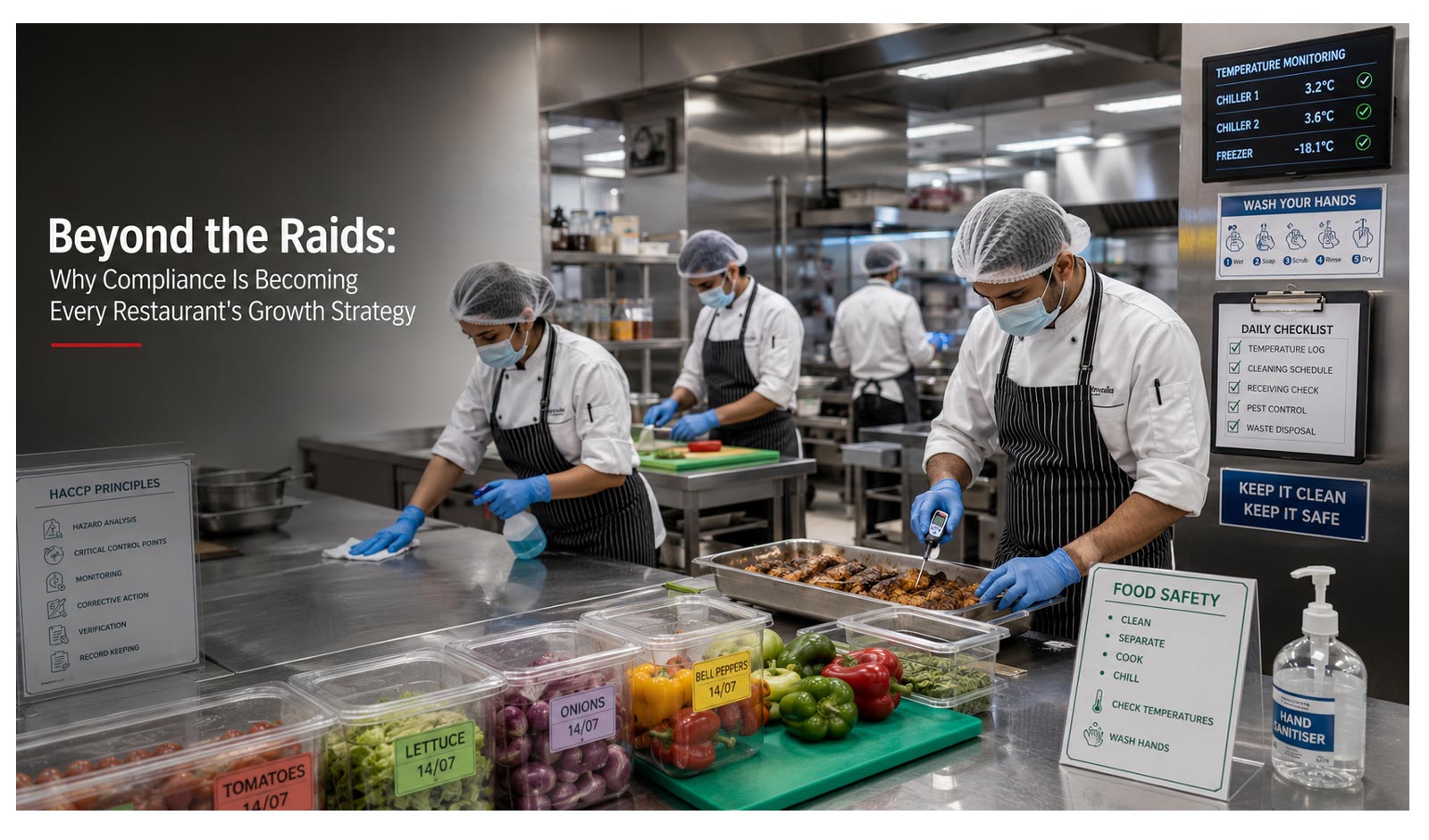
This makes food safety not just an operations issue, but a trust issue. For restaurant operators, the answer cannot simply be another inspection when a complaint arrives. Food safety needs to become a daily operating checklist.
Know the Source of Your Ingredient: Food safety starts before an ingredient reaches the kitchen. Restaurants need clear supplier verification, approved vendor lists, receiving checks and documentation for high-risk ingredients. The condition, packaging, date and temperature of incoming products should be checked rather than accepting deliveries purely on the basis of a supplier relationship.
Sandeep Anand Goyle, NRAI Delhi Chapter Head, highlighted the importance of the quality and sourcing of raw materials and ingredients, noting that they should meet the highest standards and comply with FSSAI requirements during an industry meet with the food safety regulator.
Check Before You Store: Receiving is only the first checkpoint. Ingredients should be inspected for expiry, damage, contamination, temperature abuse and packaging integrity before being moved into storage. Restaurants also need systems to ensure that products nearing expiry are identified and used appropriately.
The recent Delhi inspections reportedly found spoiled and fungal-growth-affected food, uncovered food and damaged storage containers at JW Marriott, while Andaz was reported to have expired food products, including approximately 87 kg of expired sweets.
"Food safety is not the sole responsibility of the chef or the culinary team it is a collective responsibility across the entire hotel. While chefs are accountable for safe food handling, preparation and kitchen practices, several critical controls sit with other departments," mentioned Chef Altamsh Patel.
Temperature Control Cannot Be a Paper Exercise: Cold storage, cooking, holding and reheating temperatures need regular monitoring. A temperature log that is completed only because an auditor may ask for it is not a food-safety system. Restaurants need routine checks, calibrated equipment and corrective action when temperatures move outside prescribed limits. FSSAI's observations at the Delhi properties included concerns around temperature control and food storage conditions.
Pest Control Must Be Continuous: A pest-control contract alone does not make a kitchen pest-free. Restaurants need regular inspections, documented treatments, corrective action and monitoring across kitchens, storage rooms, waste areas and receiving zones. Cockroaches, fruit flies, houseflies and mosquitoes were among the pest-related observations reported during the Delhi inspections.
Don't Ignore Water: Potable water is an often-overlooked part of food safety. Water used for drinking, cooking, ice-making, cleaning and food preparation needs appropriate controls. Storage tanks, bottling systems, pipelines and cleaning procedures need to be monitored.
The Delhi inspection reportedly identified concerns around drinking-water storage and the bottling facility at JW Marriott.
Allergens Need Their Own System: As menus become more diverse, allergen management becomes increasingly important. Restaurants should know which dishes contain common allergens, prevent cross-contact and ensure kitchen teams understand the implications of substitutions and shared equipment. FSSAI's Delhi inspections specifically flagged allergen-management and segregation concerns.
Documentation Is Part of Food Safety: Licences, supplier records, temperature logs, pest-control reports, cleaning schedules, training records, product labels and corrective-action reports are not just paperwork. They create an operating history. FSSAI's recent inspections also highlighted licensing, labelling and traceability-related deficiencies, reinforcing that food safety extends beyond what happens on the kitchen counter.
But the most important question that has come into customer mind is, “Can I Trust This Restaurant?”
As per reports, diners in cities like Mumbai, Pune, Bengaluru and even Delhi have increasingly asked to see kitchens, verify ingredient invoices and record videos over perceived hygiene concerns. Some restaurants have also started displaying hygiene ratings and conducting daily kitchen audits.
This shows that consumers are no longer necessarily willing to take a restaurant's reputation as proof of safety. A premium location, expensive interiors, celebrity chef or five-star rating cannot substitute for visible and consistent food-safety practices.
"Engineering plays an important role in maintaining the correct temperature of chillers, freezers and other essential equipment. Housekeeping and hygiene teams are responsible for effective pest-control measures and maintaining appropriate standards of uniforms and cleanliness. Procurement and receiving teams have an equally important role in sourcing quality ingredients, selecting reliable suppliers and checking the condition, quality, temperature and shelf life of products at the time of delivery," added Chef Patel.
From Compliance to Culture
The recent NRAI–FSSAI engagement in Delhi is significant because it moves the conversation towards prevention rather than simply enforcement. Goyle described the initiative as an awareness programme designed to help restaurant owners understand food-safety requirements and identify areas where standards can be strengthened.
Devesh Kumar Mahla, IPS, Director North, FSSAI, similarly emphasised that regulations protect consumers, but their effectiveness depends on how well they are understood and followed across the food ecosystem.
The lesson from the latest inspections is not that five-star hotels are unsafe, nor that every restaurant has a problem. It is that no restaurant can afford to treat food safety as a one-time compliance exercise. The customer does not see the supplier audit, the temperature log or the pest-control report. They see the plate.
Food safety therefore has to move from a compliance department to an organisation-wide culture — from procurement to storage, kitchen to service, documentation to consumer communication.
Nusra
Consultant Associate Editor
A seasoned journalist with more than a decade experience in restaurant and retail business. I eat, drink, breathe and sense food as a source of my living and lifestyle. A foodie by birth and a journalist by choice. I started my career with Hindustan Times doing hard news, moving into features and finally landing myself in a food coma. Love to talk, hear and publish all food stories that makes anyone happy and hearty for more than a decade now. Apart from food, I love reading fiction, helping others and finding joy in little things...