
Chennai’s F&B Evolution: Legacy, Innovation, and the Road to Global Scale
One of the most compelling reasons Chennai-based brands haven’t aggressively expanded outward lies closer to home, the sheer potential within Tamil Nadu itself.

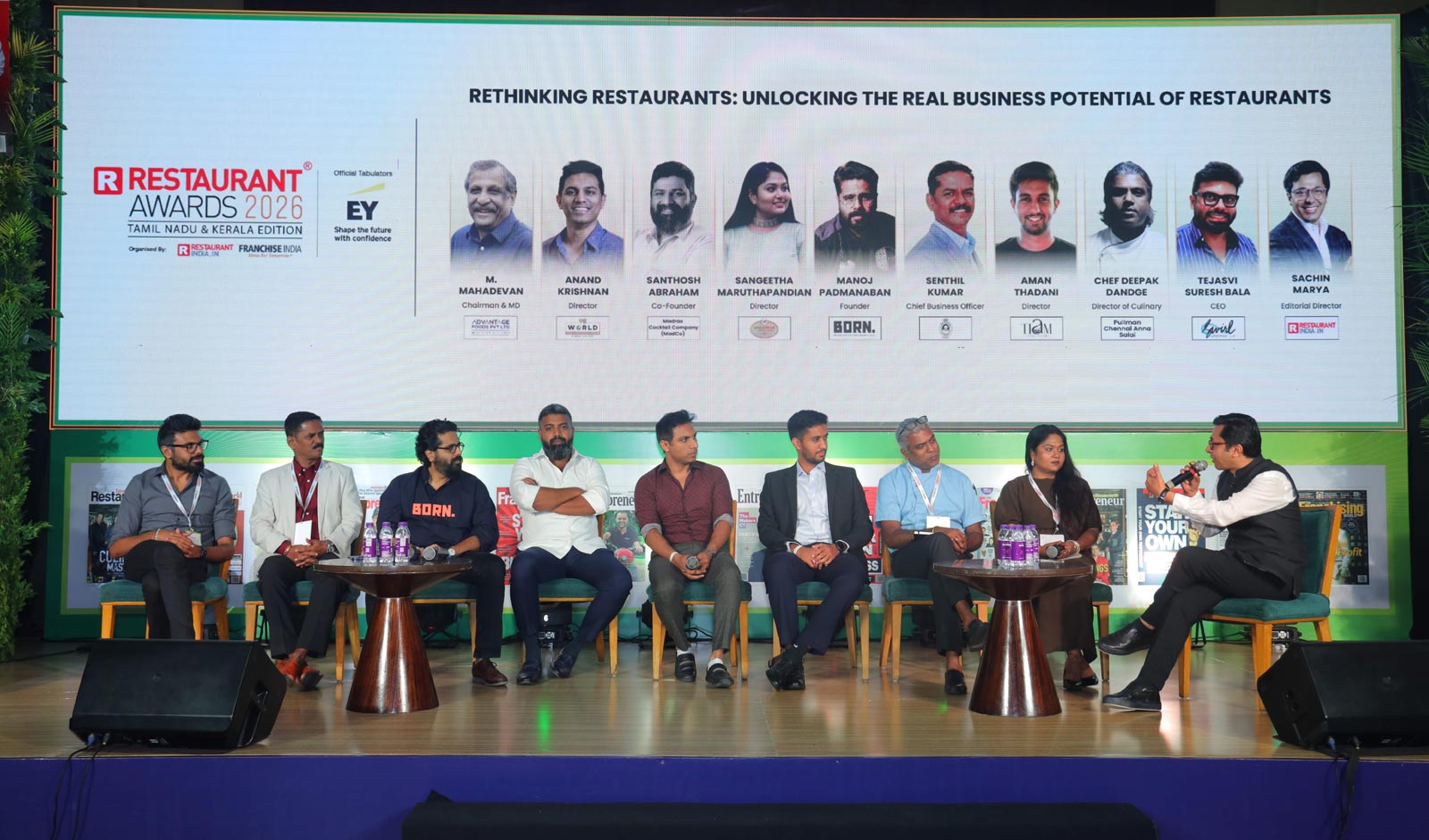
Chennai’s food and beverage ecosystem is in the middle of a powerful transition where legacy brands, new-age entrepreneurs, and experiential dining concepts are all converging to redefine what the city represents. What was once seen as a conservative, comfort-driven market is now steadily emerging as a hub of innovation, scale, and ambition.
At the heart of this transformation are multi-generational businesses that are no longer content with stability rather they are actively pursuing growth, systemisation, and global relevance.
Sangeetha Maruthapandian, Director, Anjappar Chettinad Restaurant, representing the iconic Anjappar brand, captures this shift succinctly “The second generation stabilised the business. Now, we’re focused on scaling up—bringing in systems, strategy, and innovation to take it to the next level.” This sentiment reflects a broader mindset change among legacy players who are now thinking beyond survival toward structured expansion.
The Legacy Advantage
Chennai’s legacy brands have deep roots, strong customer loyalty, and proven business models. Yet, scale especially beyond Tamil Nadu requires a different playbook.
Anand Krishnan, a third-generation entrepreneur, highlighted both the opportunity and the hesitation: “There is still a huge vacuum within Chennai itself. Even opening ten outlets here is viable. So naturally, brands expand locally before thinking of other cities or countries.”
This local-first approach is reinforced by Tamil Nadu’s economic strength and urban spread. With thriving tier-2 cities like Coimbatore, Madurai, and Trichy, brands often find enough demand within the state to sustain aggressive growth. But there are also structural challenges. Entering new markets isn’t just about capital, it’s about adaptability. “What works in Chennai cannot be replicated in Mumbai or Delhi,” Anand added by pointing that to one need to rethink the concept, understand local preferences, and most importantly, have a strong local partner.
Food as Medicine
Chennai’s food story is no longer just about tradition, it’s about transformation. From deeply rooted culinary philosophies to bold, experience-driven concepts, the city’s F&B ecosystem is evolving rapidly, shaped by both legacy wisdom and modern ambition.
Deepak Dandge, Director of Culinary, Pullman Chennai Anna Salai, drawing from history, mentioned how Tamil cuisine has always been influenced by global exchange while staying rooted in purpose. “Food from Arab countries came in through trade. Over time, colonial influences came in, people modernised, and restaurants evolved with them,” he said.
Yet, despite these shifts, the essence of the cuisine remains intact. “There’s a simple term, it’s ‘food as medicine.’ That’s what defines this cuisine,” he added. This philosophy is not just cultural rhetoric, it’s embedded in everyday cooking.
Senthil Kumar, Chief Business Officer, Dindigul Thalappakatti shared this idea with conviction, “Tamil food is not just food, it’s medicine. Every ingredient we use has a purpose.”
He pointed to something as simple as rasam: “It’s enough to take care of a cough, cold, or fever. That’s the power of our food.”
Breaking the Stereotype
Despite its depth, Tamil cuisine continues to battle a perception problem. “People think Tamil Nadu food is just rava dosa or rice,” Senthil said. “That’s a misconception. Our cuisine is about variety, masala, and flavour.” This narrow understanding has limited the cuisine’s national and global positioning. While other Indian cuisines have been successfully packaged and scaled, Tamil food often remains underrepresented or misunderstood. But the tide is slowly turning.
Deepak also added that Tamil dishes are already making their mark globally, “There are so many dishes from Chennai that have gone out into the world because they have history. Also, mainstream dining spaces are beginning to embrace this shift, signalling a growing recognition of the cuisine’s richness.”
The Tamil Nadu Advantage
One of the most compelling reasons Chennai-based brands haven’t aggressively expanded outward lies closer to home, the sheer potential within Tamil Nadu itself.
Senthil explained this with a practical lens: “Every 40–50 kilometres, you have a city that is self-sustained, with strong spending power.” This dense network of economically active towns creates a unique growth environment. “Even in a small town, a restaurant can do ₹40 lakh in business. That’s the kind of potential we have within the state.”
This abundance creates a natural incentive to expand locally rather than take on the risks of unfamiliar markets. There’s also a psychological factor. “We are comfortable here,” Senthil admitted. Why take the risk of going somewhere new when we already have a strong market?”
Risk, Comfort and Strategic Choices
Expansion is not just about opportunity, it’s about risk appetite. For many legacy brands, stepping into new geographies means navigating unfamiliar regulations, consumer preferences, and operational challenges. One misstep can damage brand reputation, making re-entry difficult. This is why many choose to stay within their comfort zone, at least initially.
However, Santhosh Abraham, Co-Founder, Madras Cocktail Company (MadCo) offers a slightly different perspective. “Tamil Nadu is one of the fastest-growing states economically. There’s still not enough bandwidth for brands to fully tap into the local market.”
He also pointed to an interesting paradox, “You often get better returns internationally because the diaspora is so strong. So, why go for the tougher domestic markets when you have low-hanging fruit abroad?”
A Changing Market Landscape
While legacy brands focus on scale and stability, a new generation of entrepreneurs is reshaping Chennai’s dining culture.
“The space in Chennai has changed. We’ve had legacy brands, but now we also have a lot of new cafes and concepts coming up. There’s the rise of niche formats like speakeasies as a sign of growing maturity. Earlier, the market wasn’t ready for something like that. Today, it is,” added Aman Thadani, Director, TIAM Foods Pvt Ltd.
His own venture reflects this evolution. “With Firo, we’ve reimagined Indian food. It’s not traditional bar food or fine dining, it’s a food-forward bar using global techniques with Indian flavours.” This blending of global and local is becoming a defining characteristic of Chennai’s new F&B identity.
The Rise of the Experience Economy
Perhaps the most significant shift is in consumer behavior. Manoj Padmanaban, Founder, BORN (Beyond Ordinary Restaurants & Nosh) captured this transformation through personal insight. “I used to go to restaurants primarily for taste. That was my habit. But travel changed his perspective. When I travel, I go for the experience. This realization led him to rethink dining formats entirely.”
“We were sceptical, would people accept Indian food in an experiential format?” he recalled. The answer, it turns out, was a resounding yes.
Today, diners are not just looking for good food, they’re seeking memorable experiences. “The food has to be good, that’s non-negotiable. But beyond that, it’s about the vibe, the energy, the way the staff interact.”
Even service styles are evolving to match this demand. “We designed uniforms, trained staff to be more interactive—chattier, playful. People now say, ‘the vibe is great,’ not just ‘the food is great.”
This has given rise to a new kind of dining spaces that blends aesthetics, storytelling, and culinary innovation. Restaurants are no longer just places to eat; they are destinations.
Nusra
Consultant Associate Editor
A seasoned journalist with more than a decade experience in restaurant and retail business. I eat, drink, breathe and sense food as a source of my living and lifestyle. A foodie by birth and a journalist by choice. I started my career with Hindustan Times doing hard news, moving into features and finally landing myself in a food coma. Love to talk, hear and publish all food stories that makes anyone happy and hearty for more than a decade now. Apart from food, I love reading fiction, helping others and finding joy in little things...









































