Capturing the Craze: How Celebrity Restaurants are Winning the Game
In the early stages, it’s often the investors who are most excited about bringing a celebrity on board. They’re the ones who get starstruck first—seeing the instant appeal and credibility that comes with a well-known name.

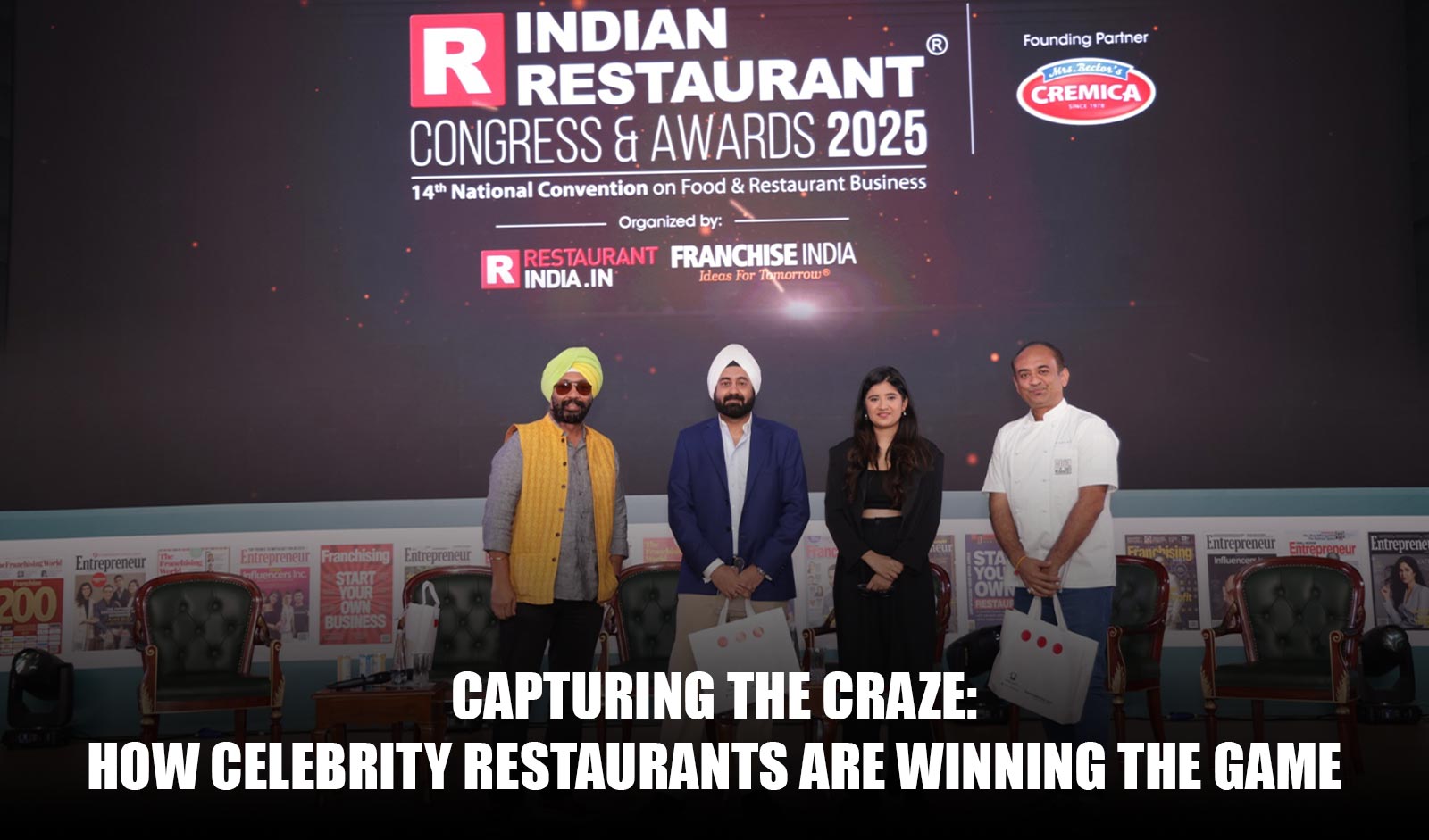
Running a celebrity-owned restaurant is not everyone’s cup of tea. It comes with its own benefits and losses. The upside is obvious—instant credibility, PR buzz, and footfall from day one. But beyond the initial hype, the product must have its own soul. People may walk in once because of the name, but they return only for the experience.
“On the current buzz around celebrities in F&B, I have mixed feelings as it’s a double-edged sword—you can get it right, but we’ve also seen many celebrity-led restaurants fail,” shared Nikita Harisinghani who runs Chrome Hospitality, which currently operates eight diverse concepts; including Kaia, a boutique hotel in Goa, in partnership with Bhumi Pednekar.
Similiarly, for Abhayraj Singh Kohli who come from an 80-year-old legacy of running restaurants— “Our first, opened in 1942, was a modest 10x20 ft space that today seats 460. Over the years, we’ve grown into Pritam, Pritam Da Dhaba, two hotels, Grandmama’s Café, Torii by Gauri Khan, The Roll Company, amongst other ventures,” he shared as for him the big question is how does he stay relevant for Gen Z? For him, nostalgia is their biggest strength—and Gen Z loves it. The key is to preserve the soul while evolving with the times. Pritam became Pritam Dhaba, adding an experiential layer to its heritage.
“Breaking into the restaurant business is no small feat. But imagine unlocking that door with the magnetic pull of a celebrity chef. It’s not just about serving food anymore—it’s about stepping directly into the heart of pop culture. When a celebrated chef lends their name and craft to your restaurant, you aren’t just getting recipes on a plate; you’re inheriting decades of credibility, nostalgia, and a ready-made emotional connection with the audience,” added Kohli by mentioning that FMCG brands rope in celebrities to endorse something as simple as toothpaste, transferring trust instantly to their product. Now, take that principle and magnify it tenfold. In hospitality, having a celebrity chef on board isn’t mere endorsement—it’s deep integration. Their persona, their culinary legacy, and their authenticity become part of your brand DNA from day one.
And, we all know that this is not an easy play. It requires vision, resources, and the courage to align with a personality larger than the restaurant itself. But if you manage to secure it, you catapult yourself into a higher league from the very start. It’s more than visibility—it’s instant gravitas.
“In a crowded industry where everyone is competing for attention, a celebrity chef partnership doesn’t just put you on the map—it places you at the top of it. The food brings people in. But the story, the nostalgia, and the credibility keep them coming back. Do everything else right, and the sky won’t just be the limit—it will be the beginning,” he further pointed.
What’s in A Name?
“I am not born out of television, I am born out of a karai and a chula,” tells Chef Harpal Singh Sokhi whose journey as a chef began with pure cooking, long before the cameras. Today, he runs Karigiri, a brand with 11 restaurants and a cloud kitchen, along with consulting projects. But beyond operations, his philosophy remains simple: food is emotion, and restaurants are stories. Legacy brands inspire me deeply. Whether it’s Ghazali with fish curry or Pritam Da Dhaba outside Dadar station, their strength lies in consistency. I want Karigiri to be remembered in the same way—relevant yesterday, today, and tomorrow. When I first entered television, my director asked, “How will people remember you after you die?” That question shaped Namak Shamak—a thought that guides my restaurants too. For me, legacy is about being remembered long after we’re gone,” he shared proudly.
As a chef, often seen as a celebrity, his mission is clear: make the word chef respected in every home, every city, even tier-4 towns.
The fact is that the plate needs to speak for itself. The product has to stand. One has to respect the plate. And, these are all seen as an emotion.
Built on Partnerships
In the early stages, it’s often the investors who are most excited about bringing a celebrity on board. They’re the ones who get starstruck first—seeing the instant appeal and credibility that comes with a well-known name. For them, the allure isn’t just short-term buzz; it’s the long-term brand equity that a celebrity association creates. Even years down the line, the brand continues to carry that halo effect—the recognition, trust, and value that only a celebrity can infuse from the very beginning.
“On day one, celebrity partnerships give you the visibility everyone dreams of. But beyond the glamour, the real success lies in how organically the collaboration comes together. Take our partnership with Bhumi Pednekar for our boutique hotel, Kaya. It wasn’t brokered through an agency or wrapped in layers of management—it was a friend-of-a-friend connection that grew into something meaningful. Our brand stood for slow living and sustainability; she was passionate about the same values and is today a United Nations Advocate for Sustainability. It was a natural fit—two worlds aligned, and two plus two equalled five,” shared Harisinghani by pointing that star power alone is not enough. Too many promoters get so dazzled by the celebrity factor that they ignore the fine print. “We’ve learnt, sometimes the hard way, that contracts and clarity matter as much as creativity. Define roles, scope, and expectations upfront—it saves endless friction later.”
Commenting on the same, Sokhi mentioned, “Especially for FMCG products, I keep getting this, probably one every day, that Ek reel kar do. So, it's a blunt no to them. I don't want a one-night stand as at this stage of my journey, I find myself saying “no” far more often than before. And that’s intentional. If a collaboration doesn’t align with the brand’s pulse, no amount of money or persuasion makes sense. Too often, agencies step in with their own agendas, chasing commissions rather than brand chemistry. Five years ago, I might have simply said, “Let’s wrap it up—money is on the table, just deliver and move on.” But not anymore.”
For owners, the view is simple: let the brand lead. The brand knows what it needs. The rest should follow. True partnerships aren’t built on transactions—they’re built on emotions, relationships, and trust. Unless that equation is real, no formula will stick. And speaking of formulas, the conversation always circles back to one question: unit economics versus the money spent on celebrity collaborations.
“Yes, you can call it a brand-building exercise, an investment in long-term equity, or a push for visibility. But if it doesn’t genuinely serve the brand’s vision and connect authentically with its audience, it’s just another expense dressed up as strategy. At the end of the day, the responsibility lies with you, the promoter. If the brand thrives, the credit is yours. If it stumbles, the accountability is yours too. A celebrity may amplify your story—but it’s still your story to lead,” pointed Sokhi.
Balancing it Right
“I'll tell you, there's a difference and I clearly always say there's a difference between a celebrity partner, and an influencer. That one reel, one comment, one entry, one visit to the restaurant, you have to treat them like an influencer and a partner is someone who's hand-holding you through the entire journey. A partner is on your balance sheet. They are part of your profits and your losses. And they're part of your journey completely from now to wherever you reach. They are the upside and downside. And when somebody gets attached to you in that form is when you should be acceptable to a partnership, otherwise not,” shared Kohli as he runs Torii in partnership with Gauri Khan.
Hence, from a P&L perspective it needs to be a long-term association. Without that they don't have any skin in the game. Hence, it’s not just merely a partnership, it’s the overall game.
Nusra
Consultant Associate Editor
A seasoned journalist with more than a decade experience in restaurant and retail business. I eat, drink, breathe and sense food as a source of my living and lifestyle. A foodie by birth and a journalist by choice. I started my career with Hindustan Times doing hard news, moving into features and finally landing myself in a food coma. Love to talk, hear and publish all food stories that makes anyone happy and hearty for more than a decade now. Apart from food, I love reading fiction, helping others and finding joy in little things...