
Why Ingredient Standardisation is the New Recipe for Growth
Ingredient standardisation is emerging as one of the industry's most effective tools for protecting margins while scaling profitably.

As India's foodservice market races towards the ₹9 lakh crore mark by 2030, restaurant operators are discovering that growth is no longer just about opening more outlets, it's about delivering the same plate, every single time. Ingredient standardisation is emerging as one of the industry's most effective tools for protecting margins while scaling profitably.
Prioritising Ingredient Standardisation
As restaurant brands expand through franchising, cloud kitchens and multi-city operations, ingredient standardisation has become a competitive necessity. By setting fixed standards for sourcing, quality, portion sizes and preparation, restaurants reduce waste, control costs and deliver consistent taste and quality across every outlet.
“Even small variations in portion sizes can significantly impact costs when multiplied across hundreds of orders. Standardised recipes ensure consistent ingredient usage, improve food-cost accuracy, reduce waste, and enable better pricing—helping restaurants protect margins without compromising quality,” said Anil Kumar, Co-Owner, Singh Sahib.
Commenting on the trend, Girjashanker Vohra, Co-founder, Depot48, said, “Restaurants are prioritising standardisation as costs rise, skilled labour becomes more mobile, and brands expand rapidly. You can no longer rely on one great chef to drive the business. Your recipe book must become the restaurant’s Bible, a single source of truth that captures years of testing, refinement, and learning.”
And every recipe should be yield-tested, photographed, costed and documented so knowledge belongs to the business, not an individual.
Profitability in Mind
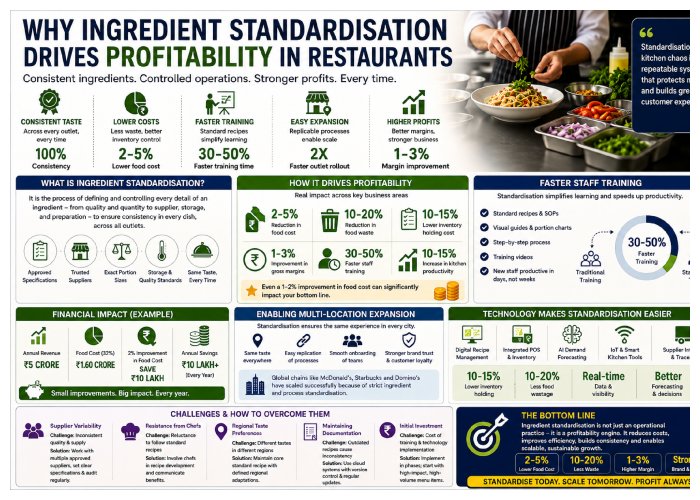
Food accounts for 25–40% of a restaurant's revenue, making it the largest controllable cost. Ingredient standardisation reduces waste, over-portioning and inconsistencies, helping cut kitchen waste by 10–20%, improve inventory control and significantly boost profitability.
Shantanu Yadav, Co-Founder, Atmanaam said, “For growing restaurant brands, this becomes even more important. When every kitchen follows the same systems, sourcing standards, and quality benchmarks, it becomes much easier to deliver a consistent guest experience across multiple locations. Consistency is what builds trust with our guests, and standardisation provides the operational foundation that allows expansion while preserving the authenticity and quality that define the brand.”
“Food costs typically account for 28–35% of restaurant revenue, so reducing ingredient variance and wastage by even 2–3% can add several lakh rupees annually to the bottom line of a single outlet without increasing menu prices,” added Vohra.
Ingredient standardisation is not just about maintaining consistency, it directly impacts profitability. “Restaurants with standardised recipes and ingredients can reduce food costs by 3–8%, lower wastage by 10–20% and improve operational efficiency by 10–15%,”explained Kumar who also added that this translates into an increase in net profitability of around 2–5%, while ensuring every guest enjoys the same authentic experience, every single time.
Faster Staff Training
High kitchen staff turnover, often 50–80% annually, makes training expensive and time-intensive. Standardised recipes, digital SOPs and portion guides simplify onboarding, enabling new staff to become operational within 7–14 days.
Anurag Singh, CEO of Temple Street said, “For brands operating across multiple outlets, ingredient standardisation is no longer optional, it's essential. It allows restaurants to maintain food quality, streamline procurement, improve inventory planning, and ensure every plate reflects the brand's promise.”
Kumar pointed, “Standardisation simplifies training because employees do not have to rely solely on individual experience or the personal interpretation of a chef. A clearly documented recipe provides the exact ingredient quantities, preparation methods, portion sizes and plating guidelines that need to be followed. This can significantly reduce the learning curve for new employees and make the training process more structured.”
“In a well-managed restaurant, standardised recipes and portion control can typically reduce food wastage by 10–25% and improve food cost management by 5–8%. Consistent procurement practices can also lower inventory losses while improving forecasting accuracy,” added Yadav.
Hence, brands that combine standardised recipes with digital tools, AI forecasting and integrated inventory systems will be better positioned to improve margins, scale efficiently and deliver a consistent customer experience.
Vijetha Iyer
Content Editor
Working as a Content Editor with Restaurant India. I have worked in various sectors like food and beverage sector, chemicals, pharma, nutraceuticals, now specially focusing on restaurant side. But my core knowledge was always on content. Be it writing poems to verses, I always loved writing and have been exploring my career on the same. In Restaurant India, I deliver insightful stories, take interviews of various brands and update the audiences about the newest happenings in the restaurant industry.









































