The New Real Estate for QSRs: Petrol Pumps, Airports and Transit Hubs
The new restaurant real estate is not simply where people gather. It is where people pause—and where a QSR can make that pause worth something.

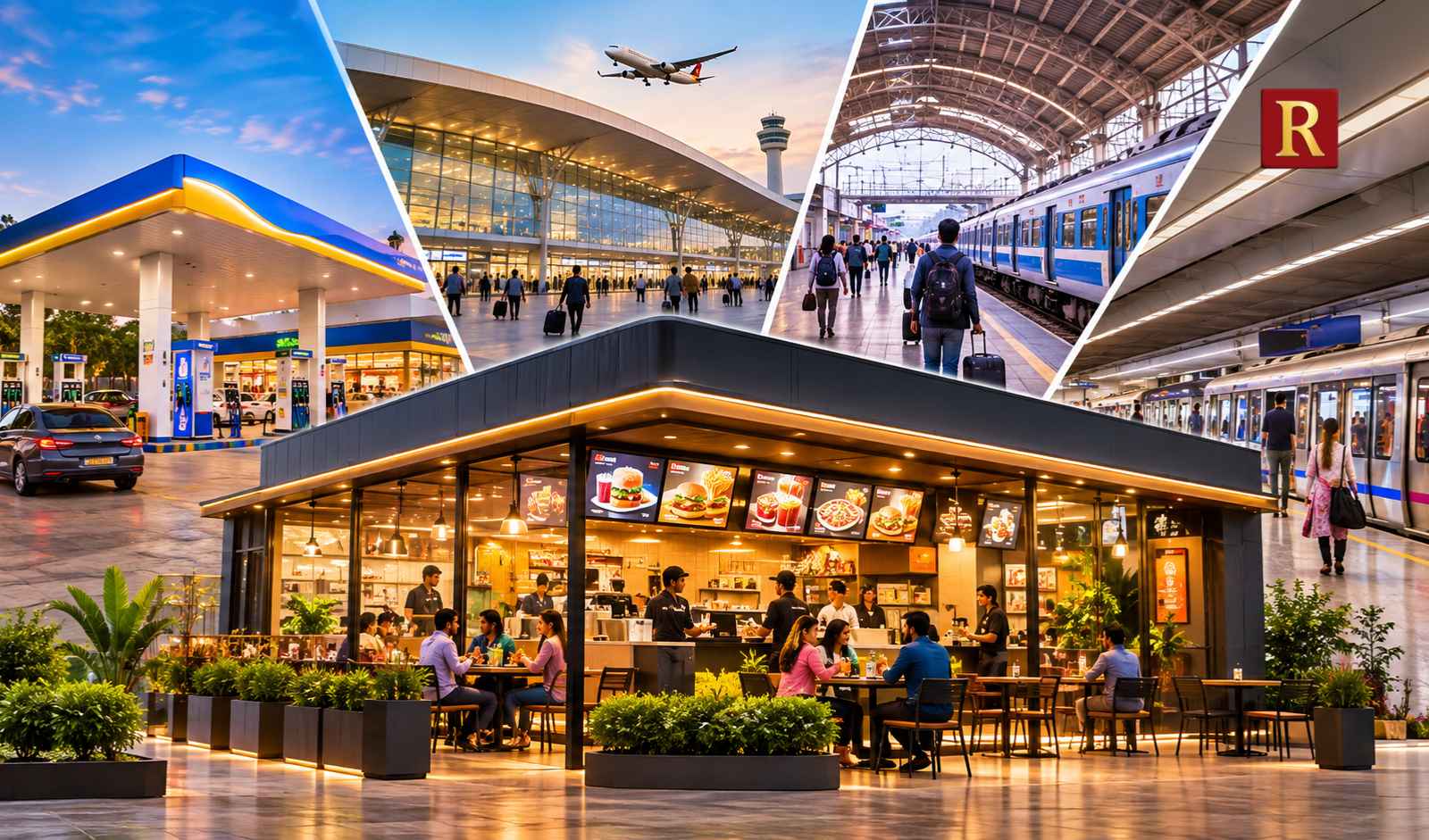
India's quick-service restaurant (QSR) industry is looking beyond high streets, shopping malls and traditional commercial spaces to find its next growth opportunity. Petrol pumps, airports, railway stations, metro networks and highway food plazas are increasingly becoming attractive locations for food businesses looking to reach consumers while they are travelling. The shift is changing how restaurant brands evaluate real estate. Instead of depending entirely on residential catchments, office crowds or shopping traffic, QSRs are exploring locations where consumers are already stopping for fuel, waiting for flights, catching trains, charging electric vehicles or commuting to work.
These locations offer access to a different kind of demand. Customers may not have planned to visit a restaurant, but they may be looking for coffee, breakfast, a quick meal, snacks or something to take along on their journey. As India's mobility infrastructure expands and travel retail develops, petrol pumps, airports and transit hubs could become an increasingly important part of the QSR expansion playbook.
Petrol Pumps Are Becoming More Than Fuel Stops
Fuel stations are evolving into multi-service destinations where customers can refuel, eat, shop, use washrooms and recharge electric vehicles. For QSR brands, this creates an opportunity to reach customers without requiring them to make a separate detour to a restaurant. The shift is being supported by oil companies looking to increase revenue from non-fuel services. Indian Oil, for instance, has discussed plans to expand its non-fuel retail outlets from around 8,000 to 20,000–25,000 by 2030, with food, retail and convenience services forming part of this broader strategy.
Recent partnerships are also making this opportunity more concrete. Vikram Kamats Hospitality has partnered with HPCL to establish South Indian food outlets at selected fuel stations, while MB Chicken has entered a partnership to develop dine-in and drive-through outlets at select HPCL locations in Punjab and Haryana. For QSR brands, petrol pumps can offer different formats depending on the available space and traffic. Larger sites can accommodate dine-in restaurants, drive-through lanes and family seating, while smaller locations may work better with coffee counters, takeaway windows or compact kitchens.
EV charging could create a new food-consumption window
The growth of EV charging infrastructure could further change the food business at fuel stations. Unlike conventional refuelling, charging may require customers to spend more time at the location, depending on the vehicle, charger and charging requirement. That waiting period creates an opportunity to sell coffee, quick meals, desserts and snacks. Brands could develop charging-friendly combos, timed offers, pre-orders or meal bundles that customers can pick up without interrupting their charging session. The opportunity is to make the waiting period useful for both the consumer and the restaurant—without assuming that every charging customer will automatically spend more.
Airports Are Becoming Multi-Format Food Markets
Airports have long been attractive to restaurant operators because they bring together domestic and international travellers, business passengers, tourists and airport employees. However, airport food retail is evolving beyond traditional food courts and premium restaurants. The new opportunity lies in building a mix of formats that serve customers with different budgets, schedules and food preferences. Coffee counters, burger outlets, sandwich kiosks, regional Indian food, premium dining, bakeries and packaged food stores can all operate within the same airport ecosystem.
The growth of India's airport infrastructure is also attracting organised travel-food operators. Travel Food Services, for example, reported in November 2026 that its network had expanded to 22 airports, with 570 total outlets across its business and 156 brands in its portfolio. It also reported mobilising more than 70 travel QSR outlets over the preceding 12 months. This reflects the scale and specialisation of travel food retail as a business category.
The airport customer is not always the same
A passenger rushing towards a boarding gate may want coffee and a sandwich in less than five minutes. Someone arriving early may prefer a full meal, while a family may look for a restaurant with comfortable seating and a children's menu. For brands, this means the airport location alone is not enough. The outlet's placement within the terminal, distance from security, visibility, boarding time and service speed can determine whether a passenger purchases. Airport QSRs must also account for concession fees, operating restrictions, staffing across flight schedules, supply logistics and menu consistency. High footfall can offer scale, but profitability depends on how effectively the outlet converts traffic into transactions.
Railway Stations Could Become the Next Major QSR Expansion Frontier
Railway stations could offer a major opportunity for organised food chains to reach India's mass-market travelling population. Unlike airports, stations serve customers across a wider range of spending capacities, journey lengths and travel purposes. A change in Indian Railways' catering policy has introduced the Premium Brand Catering Outlet category, allowing established national food brands to seek station locations through a formal bidding process. The move is aimed at improving passenger experience, food standardisation and non-fare revenue. The opportunity could extend to brands across burgers, pizza, sweets, bakery, snacks, beverages and Indian meals. However, railway stations require a different pricing strategy from airports or premium malls.
Brands will need to consider:
- Affordable meals for price-conscious passengers
- Portable food for customers boarding trains
- Fast order preparation during train arrival windows
- Packaging that is easy to carry
- Regional food preferences
- Large orders from families and groups
A railway outlet may experience a sudden rush before a train arrives and a quieter period once passengers board. Kitchen preparation, staffing and inventory planning must account for these demand spikes rather than follow the predictable patterns of a conventional neighbourhood restaurant. The opportunity is not simply to introduce national brands at stations, but to build a food format that works for millions of passengers with very different needs.
Metro Stations: Small Outlets, Repeat Customers
Metro stations offer QSR brands a different advantage: repeat consumption. Unlike airport passengers or highway travellers, many metro customers use the same station several times a week, creating an opportunity to build purchasing habits around their daily commute. A compact outlet selling coffee, tea, bakery products, breakfast items, sandwiches, wraps and packaged snacks can serve commuters who have only a few minutes before their train arrives. Pre-ordering and quick pickup could further reduce waiting time during rush hours.
Travel retail operators are also expanding their presence beyond airports. IRHPL has been looking at retail and hospitality opportunities across metro infrastructure, including Mumbai Metro Line 3 locations such as BKC and the T2 Airport station. The biggest challenge for metro QSRs is not necessarily attracting customers, but serving them efficiently within limited space. Smaller kitchens, reduced menus, pre-prepared ingredients and faster payment systems become essential. For brands, metro stations could function as everyday consumption channels rather than occasional dining destinations.
How Each Location Changes the QSR Business Model
The same restaurant brand cannot necessarily operate the same menu, kitchen or service model across every travel location. The customer's reason for stopping, available time and spending behaviour change with the environment.
Location | Customer behaviour | Best suited QSR format |
Petrol pumps | Refuelling, short breaks, charging, family stops | Drive-through, café, takeaway, casual dine-in |
Highways | Longer breaks, group and family meals | Food plazas, full meals, family combos |
Airports | Time-sensitive purchases, varied spending | Grab-and-go, cafés, premium QSRs |
Railway stations | Sudden rushes, value-driven purchases | Quick takeaway, affordable meal combos |
Metro stations | Repeat daily visits, short purchase windows | Coffee kiosks, bakery, breakfast counters |
The menu also needs to reflect the location. Airport outlets may need portable meals, metro counters may prioritise coffee and breakfast, while highway restaurants can focus on family-sized portions, regional food and longer dining breaks. This is where operational planning becomes more important than simply securing a high-footfall location.
High Footfall Does Not Automatically Mean High Profit
Travel locations can attract thousands of people, but not everyone passing through is a potential customer. A QSR's success depends on the quality of traffic, purchase intent, visibility, convenience, service speed and cost structure. Restaurant expansion teams need to assess more than daily footfall before committing to a location.
The metrics that matter
Conversion rate: What percentage of passing customers actually purchase?
Average order value (AOV): How much does a customer spend per transaction?
Sales per square foot: How efficiently is the available space generating revenue?
Dwell time: How long do customers remain at the location?
Peak-hour sales: How concentrated is revenue during certain periods?
Occupancy cost: What are the lease, concession or revenue-sharing expenses?
Labour cost: How many employees are needed to manage traffic and long operating hours?
Food wastage: How much prepared inventory remains unsold during unpredictable traffic fluctuations?
Consider two locations: one attracts 20,000 people a day, while another attracts 5,000. The larger location may appear more attractive, but if its access is inconvenient, conversion is low and concession costs are high, it may generate weaker outlet-level returns. A smaller location with better visibility, stronger purchase intent, faster service and lower fixed costs could be more commercially viable. The real estate decision must therefore be based on projected sales and profitability, not footfall alone.
QSRs May Need to Build Smaller and Smarter Formats
Travel-linked real estate is also pushing brands to rethink their store formats. A conventional restaurant may require seating, a large kitchen and extensive back-of-house space. However, transit hubs and fuel stations may offer only limited space, making compact, modular and specialised formats more practical.
Brands can experiment with:
Express counters: Coffee, bakery, beverages and ready-to-serve products with minimal preparation.
Drive-through outlets: Designed for motorists who want to order without leaving their vehicles.
Micro-kitchens: Smaller menus with ingredients that can be assembled quickly.
Pre-order pickup points: Customers place orders before reaching the station or terminal.
Travel meal boxes: Packaged meals, snack combinations and beverages designed for consumption on the move.
Hybrid convenience outlets: Food combined with packaged products, travel essentials and beverages.
These formats could help brands enter locations where a conventional restaurant would be too expensive or operationally difficult. The expansion strategy could also work as a multi-format network. A brand might operate a full-size restaurant in a city, an express counter at a metro station, a drive-through at a fuel station and a takeaway kiosk at an airport. Each outlet would serve a different consumption occasion while strengthening the brand's overall presence.
The Challenges of Travel-Linked QSR Expansion
Despite the opportunity, travel-linked locations are not an easy expansion route. High traffic can come with expensive commercial terms, restrictions on deliveries, limited storage, long operating hours and sudden demand fluctuations. Brands must also consider how easily customers can access the outlet. A restaurant positioned at a highway fuel station may attract motorists only if the entrance, parking and exit are convenient. An airport outlet may lose customers if it is located too far from boarding gates. A metro kiosk may struggle if queues block commuter movement.
The key challenges include:
- High rents, concession fees or revenue-sharing commitments
- Limited kitchen and storage space
- Delivery and supply-chain restrictions
- Staffing requirements across extended operating hours
- Demand spikes linked to trains, flights, holidays or traffic
- Food safety and holding-time requirements
- Difficulty predicting customer conversion from footfall
Brands must conduct location-level feasibility studies before signing contracts. A high-profile address is not a guarantee of commercial success.
The Future
The next phase of QSR expansion in India may not be limited to finding more storefronts in crowded commercial markets. It could depend on identifying where consumers naturally stop during their journeys and building food formats around those moments. Petrol pumps can offer food alongside refuelling and EV charging. Airports can monetise waiting time through multiple food formats. Railway stations can bring organised food brands to mass-market consumers, while metro stations can create repeat purchases from daily commuters.
The opportunity is to turn movement into consumption. But the winning strategy will not be opening outlets everywhere people travel. It will be understanding why people stop, what they need during that stop, how much time they have and what makes them choose one food outlet over another. The new restaurant real estate is not simply where people gather. It is where people pause—and where a QSR can make that pause worth something.
Saptopriya Ghosal
Feature Writer
I am a dedicated media professional with a bachelor's degree in mass communication from the State University of Calcutta and a postgraduate degree from Amity University. My academic journey has equipped me with a profound understanding of storytelling and communication. Passionate about the dynamic world of media, I continually strive to explore new ways to engage and inform through compelling narratives.