LPG Crunch Puts India’s Restaurant Kitchens on Edge
To mitigate the risks, the National Restaurant Association of India has advised restaurant operators to adopt fuel conservation measures and operational adjustments to ensure business continuity.

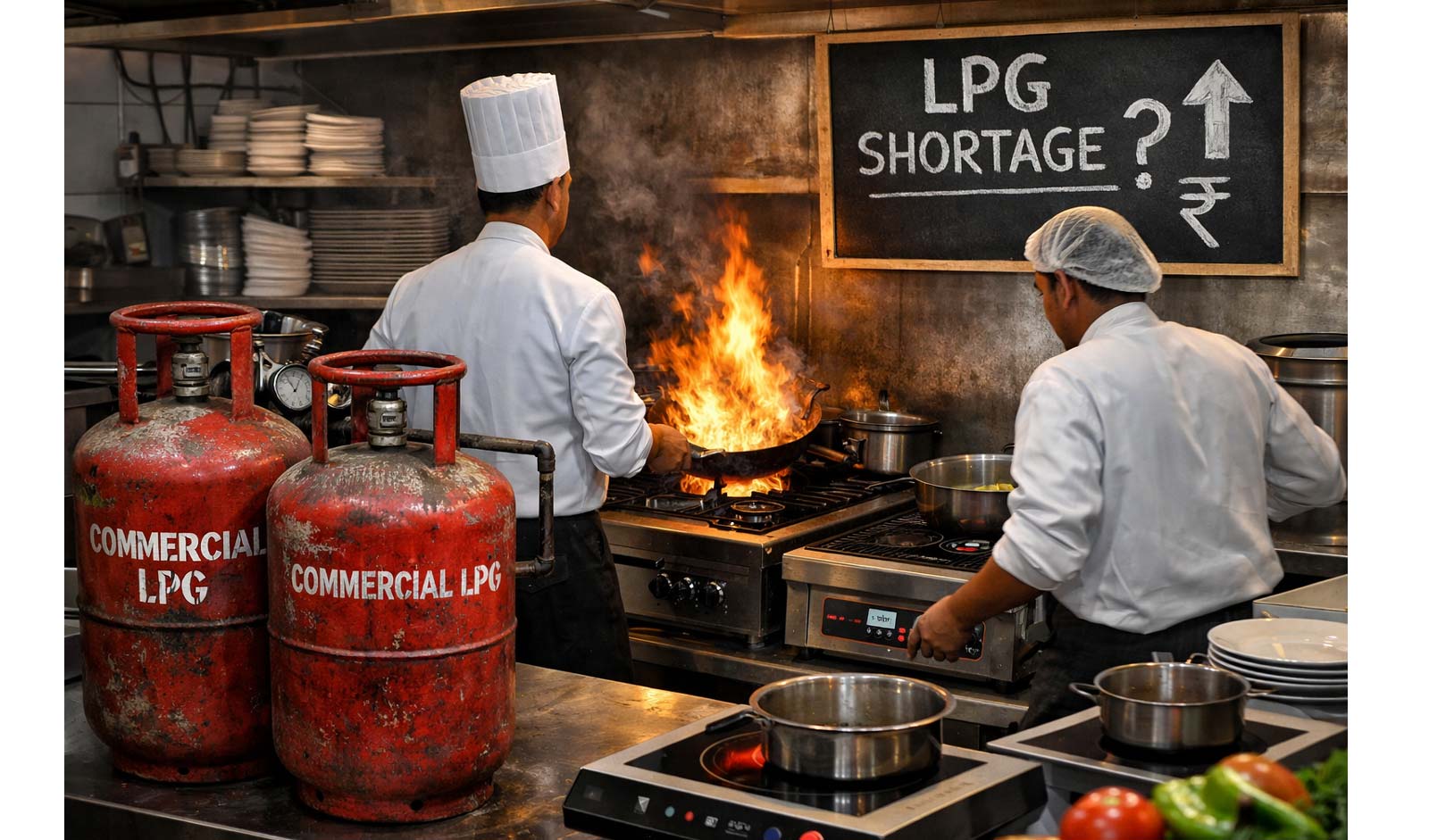
India’s restaurant industry is preparing for potential operational disruptions as uncertainty around the availability of commercial LPG cylinders raises concerns across the sector. While supply challenges are still evolving, many operators have already begun adopting precautionary measures, from optimizing kitchen operations to exploring alternative energy sources to ensure that service remains unaffected.
Commercial LPG remains the primary fuel for most restaurant kitchens across the country. Although piped natural gas (PNG) is available in some malls and select commercial areas, a large number of restaurants still depend heavily on LPG cylinders to run their daily operations.
Restaurants Rethink Fuel Use Amid LPG Volatility
The recent volatility in supply and pricing has therefore pushed restaurant operators to rethink how they manage fuel usage and kitchen efficiency.
Vikrant Batra, Co-Founder, Café Delhi Heights, said that while the situation has not yet significantly disrupted operations, restaurants are closely monitoring supply chains and preparing for contingencies. “Restaurants typically rely on either PNG or commercial LPG cylinders for kitchen operations. While some outlets, especially in malls or developed commercial spaces, operate on PNG, many still depend on LPG,” he said.
Under normal circumstances, restaurants maintain only two to three days of LPG inventory because supply is usually steady. However, the current uncertainty has prompted operators to work more closely with suppliers and manage fuel consumption carefully.
“At present, we are coordinating closely with our authorized suppliers and optimizing kitchen operations to ensure there is no disruption to the guest experience,” Batra added. Café Delhi Heights, which operates nearly 50 outlets across 17 cities in India, is currently absorbing short-term cost fluctuations rather than immediately increasing menu prices. “We are continuing to adhere strictly to regulated supply channels, as safety and compliance remain a top priority,” he mentioned.
At the same time, restaurant brands are exploring alternative solutions to maintain operational continuity if supply challenges persist. “As a precautionary measure, we are also exploring contingency plans such as increasing the use of electrical equipment and induction-based cooking where feasible,” Batra explained.
Industry leaders say such adjustments are becoming increasingly important as the sector prepares for the possibility of prolonged supply constraints.
Industry Flags Supply Shortages and Limited LPG Buffers
Amit Bagga, Co-Founder of Daryaganj Restaurants and Co-Chapter Head of the Delhi Chapter of the National Restaurant Association of India (NRAI), highlighted that while some restaurants operate on PNG, a significant number still depend entirely on LPG cylinders.
“In Delhi, some mall-based restaurants and a few high-street outlets already operate on PNG wherever the network is available. However, a large number of restaurants still rely primarily on LPG cylinders,” Bagga added.
According to him, the current challenge is not only about rising prices but also about the availability of cylinders in the market. The situation has also triggered concern within the industry about possible panic buying or hoarding following widespread media coverage around the shortage.
“Most restaurants do not maintain more than one to two days of LPG inventory. If the situation is not addressed quickly, it could lead to restaurant closures, which would have wider implications as the livelihoods of restaurant staff could be affected,” Bagga warned.
Additionally, some recent notifications have suggested lower priority for commercial establishments in LPG cylinder supply. According to industry leaders, monitoring such policies effectively on the ground could be difficult and may further complicate access to fuel for restaurants.
Abhik Mitra, Managing Director and CEO, Paradise Food Court Pvt Ltd, said the situation highlights the importance of building stronger supply resilience within restaurant operations.
“The current constraints around commercial LPG supply are a concern for the hospitality sector as cooking fuel is central to restaurant operations. At Paradise, we are closely monitoring LPG inventory across our network and working with supply partners to ensure continuity. We are also evaluating alternative cooking mechanisms, including electricity-based solutions where feasible, to maintain uninterrupted operations,” he said.
He added that during this period the brand will remain focused on its core offerings. “Our focus will remain on signature dishes such as biryanis, haleem and kebabs, ensuring that we continue to deliver the same quality and consistency that customers expect from Paradise.”
Industry stakeholders also point out that global geopolitical developments are contributing to supply chain disruptions for commercial LPG.
Sagar Daryani, CEO and Co-Founder, Wow! Momo and President, NRAI, noted that if the situation escalates and supply tightens further, the restaurant sector could face serious operational challenges.
To mitigate the risks, the National Restaurant Association of India has advised restaurant operators to adopt fuel conservation measures and operational adjustments to ensure business continuity. The association is also engaging with authorities to ensure that the restaurant industry is recognized as an essential supply and employment-generating sector. It has urged policymakers to safeguard commercial LPG allocations and consider emergency supply mechanisms if disruptions worsen.
The restaurant industry supports millions of livelihoods across India—from chefs and service staff to farmers, suppliers, and logistics partners. For operators, ensuring uninterrupted kitchen operations is therefore not only about business sustainability but also about protecting jobs across the broader food service ecosystem.
While the industry remains hopeful that supply conditions will stabilize soon, many restaurant brands are already adapting their operations to navigate the uncertainty and ensure that dining experiences remain uninterrupted.
Nusra
Consultant Associate Editor
A seasoned journalist with more than a decade experience in restaurant and retail business. I eat, drink, breathe and sense food as a source of my living and lifestyle. A foodie by birth and a journalist by choice. I started my career with Hindustan Times doing hard news, moving into features and finally landing myself in a food coma. Love to talk, hear and publish all food stories that makes anyone happy and hearty for more than a decade now. Apart from food, I love reading fiction, helping others and finding joy in little things...