
International Burger Day: How India’s Burger Economy is Reinventing Itself
From budget-friendly aloo tikki burgers priced from ₹50 to indulgent gourmet or premium creations featuring regional sauces, handcrafted buns, millet-based patties, and bold Indian flavours, burgers are steadily emerging as one of the country’s most preferred comfort foods.

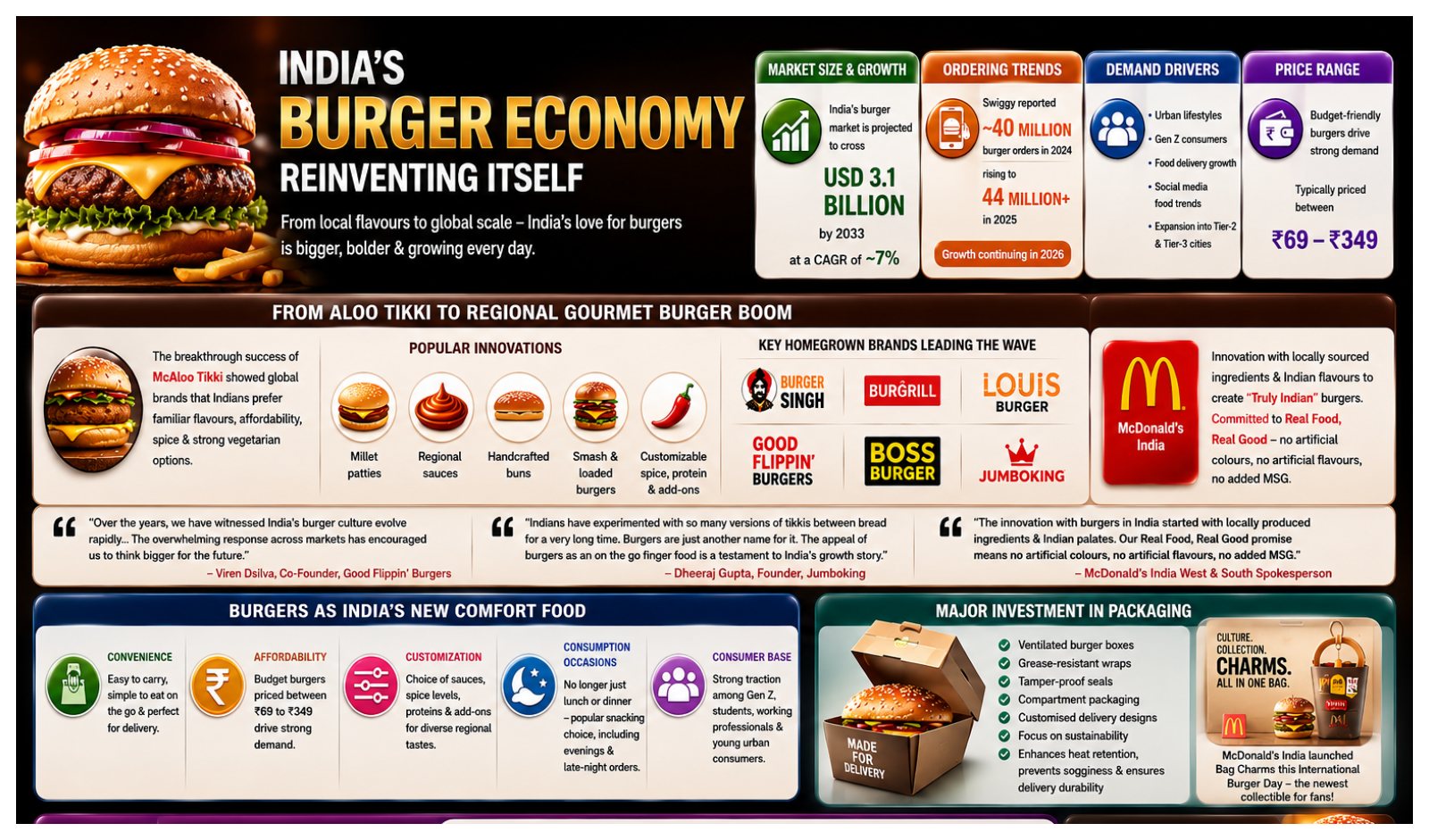
India’s burger segment is witnessing a major evolution within QSR space. What was once perceived as a largely Western fast-food concept led by international brands has now transformed into a highly localized and innovation-driven food category. From budget-friendly aloo tikki burgers priced from ₹50 to indulgent gourmet or premium creations featuring regional sauces, handcrafted buns, millet-based patties, and bold Indian flavours, burgers are steadily emerging as one of the country’s most preferred comfort foods.
The shift has been fuelled by the rapid growth of food delivery platforms, changing Gen Z eating habits, the expansion of homegrown burger brands, and the influence of social media-driven food trends.
Burger Economy is Growing
India’s burger market is expanding steadily, driven by urban lifestyles, younger consumers, and the rapid growth of food delivery platforms. As per reports, the market will cross USD 3.1 billion by 2033 at a CAGR of around 7 percent.
Burgers have also become a dominant part of India’s ordering culture. Swiggy’s food trend reports highlighted that close to 40 million burgers were ordered in 2024, rising to over 44 million in 2025 which has increased in 2026 as well. The growth is no longer restricted to metro cities, as Tier-2 and Tier-3 markets are emerging as major demand drivers for organized burger chains.
From Aloo Tikki to Regional Gourmet Burger Boom
India’s burger evolution began with localization. The breakthrough success of the McAlooTikki showed global fast-food brands that Indian consumers preferred familiar flavors, affordability, spice, and strong vegetarian options over purely Western-style offerings.
Homegrown brands including Burger Singh, Burgrill, Louis Burger, Good Flippin’ Burgers, Boss Burger, along with several regional café-driven chainsare leading this wave of experimentation.
Viren Dsilva, Co-Founder, Good Flippin’ Burgers said, “Over the years, we have witnessed India’s burger culture evolve rapidly, and it’s been incredible to see Good Flippin’ Burgers become a favourite among consumers looking for quality, comfort, and familiar flavours done right.”
“Indians have experimented with so many versions of tikkis between bread for a very long time. Burgers are just another name for it. Beyond packaging, we are curious about our customer’s palate and its evolutionand constantly seek to serve them with the best of Indian and international experiences. The appeal of burgers as an on the go finger food is a testament to India’s growth story,” added Dheeraj Gupta, Founder, Jumboking.
Burgers as India’s New Comfort Food
Today, burgers are steadily carving out their own space, particularly among Gen Z and young urban consumers who are embracing quick, familiar, and satisfying meal options. One of the biggest reasons behind this shift is convenience. Burgers are easy to carry, simple to eat on the go, and perfectly suited to India’s fast-growing food delivery ecosystem.
Affordability is another major factor driving popularity. Budget-friendly burgers priced between ₹69 to ₹349 continue to generate strong demand, helping brands attract frequent and repeat consumers. Customization has also made burgers more appealing to Indian diners. Consumers now have the flexibility to choose different sauces, spice levels, proteins, and add-ons, allowing brands to cater to diverse regional tastes and preferences.
“The innovation with burgers served at every McDonald’s restaurant in India started with locally produced ingredients - what Indian pantries hadand palates craved for. They became balanced burgers that are Truly Indian. That commitment extends beyond flavour with our Real Food, Real Good promise which means no artificial colours, no artificial flavours, no added MSG, because a burger made for India should be genuinely good for India too,” commented McDonald’s India West and South spokesperson.
Major Investment in Packaging
Packaging has become a key investment area for burger brands as food delivery demand continues to grow across India. Beyond simply transporting food, packaging now plays an important role in maintaining heat, preventing sogginess, ensuring delivery durability, supporting sustainability goals, and strengthening brand visibility.
To improve customer experience, brands are increasingly using ventilated burger boxes, grease-resistant wraps, tamper-proof seals, compartment packaging, and customised delivery designs, especially for smash and loaded burgers that are harder to transport.
McDonald's India stated that a customer’s experience is also enhanced through moments that hold cultural resonance in their daily lives. “This year for International Burger Day we launched Bag Charms, as the newest addition to the growing line of collectible merchandise by McDonald's India.”
At the same time, burgers are no longer limited to lunch or dinner occasions. They have become a popular snacking choice, especially during evening hours and late-night ordering windows, reflecting changing eating habits among younger consumers.
Vijetha Iyer
Content Editor
Working as a Content Editor with Restaurant India. I have worked in various sectors like food and beverage sector, chemicals, pharma, nutraceuticals, now specially focusing on restaurant side. But my core knowledge was always on content. Be it writing poems to verses, I always loved writing and have been exploring my career on the same. In Restaurant India, I deliver insightful stories, take interviews of various brands and update the audiences about the newest happenings in the restaurant industry.









































