Food safety has become one of the defining conversations in India's restaurant industry. Recent inspections by the Maharashtra FDA have brought regulatory compliance into sharp focus, but beyond the headlines lies a much bigger shift, food safety is evolving from a statutory obligation into a core business strategy. High-profile establishments, including Flint & Waarsa, Poornima Restaurant and several other restaurants, hotels and bakeries, have come under scrutiny for alleged food safety and hygiene violations.
While the enforcement drive has sparked debate over regulatory processes and due process, it has also highlighted a larger reality that food safety is no longer just a compliance requirement, it has become a business imperative.
As India's food services market is projected to cross USD 125 billion by 2030, making food safety and operational governance increasingly critical as brands scale. The recent enforcement drive has also coincided with changing consumer expectations. Diners today are paying closer attention to hygiene, food handling practices and operational transparency, making compliance an important part of a restaurant's brand reputation rather than just a regulatory requirement.
According to Vineet Kochar, Chief Operating Officer, Azure Hospitality, consumers today evaluate restaurants on trust as much as taste.
"Hygiene and transparency are no longer operational differentiators—they are fundamental to brand credibility and guest loyalty."
Maharashtra FDA Commissioner Tukaram Mundhe has shared that the enforcement drive is aimed at strengthening food safety rather than targeting businesses indiscriminately. Emphasising public health and accountability, he said the guiding principle behind the statewide campaign is "Safe Food, Safe Drugs, Safe Maharashtra."
In an earlier interview with The Indian Express, Mundhe said, "This is part of a systematic and focused enforcement plan. At the same time, we are committed to ensuring ease of doing business for compliant operators. Honest businesses have nothing to fear, but those violating the law will find no place to hide and will face strict prosecution."
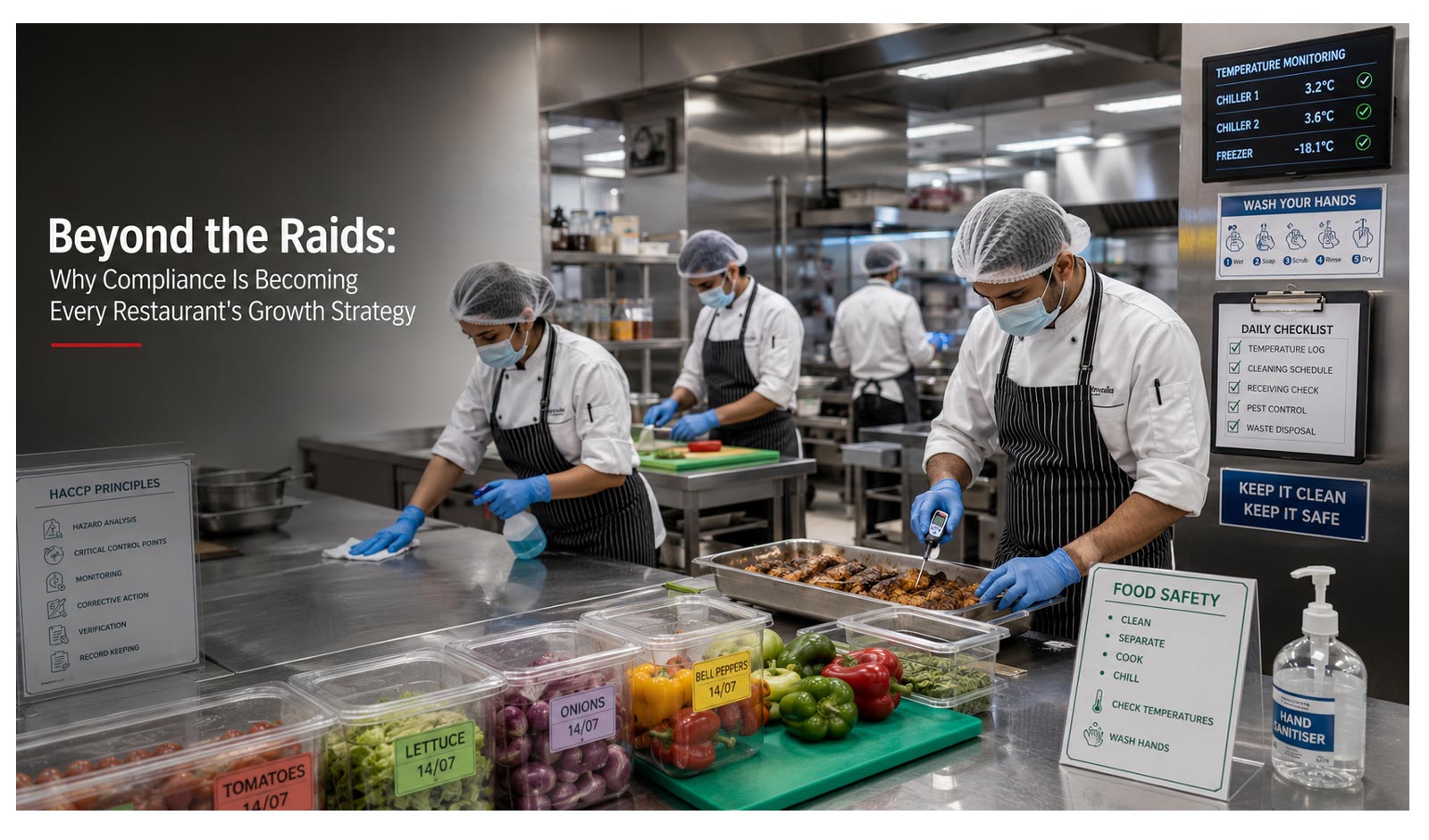
We can say that today compliance is no longer optional, and food safety must become a continuous operational discipline rather than a reactive exercise. And, for India's restaurant industry, the conversation is now shifting from reacting to inspections to building systems that make compliance an everyday practice.
Compliance Begins Long Before an Inspection
Industry leaders believe the strongest restaurants are those where food safety is embedded into daily operations rather than activated only when regulators arrive.
According to Ishan Bahl, Director, Khyber Restaurant, compliance should never depend on inspections.
"Food safety isn't something that can depend on whether an inspection is taking place. It has to be embedded into the DNA of the business. The strongest restaurants are built on robust systems, clearly defined SOPs, regular audits, and a culture where every team member is accountable for maintaining the highest standards every single day."
He believes regulatory inspections serve an important purpose in maintaining accountability, but lasting compliance comes from sustained investment in training, processes and ownership across every level of the organisation.
"When food safety becomes a daily habit rather than a periodic checklist, both businesses and consumers benefit."
Industry leaders believe that achieving consistent food safety standards also requires sustained investment across people, processes and systems.
Kochar also pointed that leading restaurant brands are now investing well beyond minimum compliance.
"The focus is on stronger SOPs, continuous staff training, robust vendor governance, digital monitoring systems and process standardisation that ensures consistency across every outlet."
The Supply Chain Is the First Line of Defence
While restaurant kitchens often receive the spotlight during inspections, food safety risks frequently originate much earlier in the supply chain.
Nitin Nagrale, a supply chain expert and Founder HPMF, shared that supplier selection remains one of the most overlooked aspects of compliance.
"The biggest food safety risks don't usually start in the restaurant, they start much earlier in the supply chain."
According to him, restaurants often prioritise price over supplier credibility, exposing themselves to avoidable risks. "A supplier may offer an attractive rate, but if they cannot consistently demonstrate compliance, traceability and quality assurance, that low price can become very expensive in the long run."
Documentation is another area where businesses frequently fall short. During inspections, restaurants must not only maintain standards but also demonstrate compliance through proper records.
Missing temperature logs, incomplete receiving records, poor stock rotation and inadequate documentation can quickly become serious compliance issues.
Nagrale also stressed the importance of ingredient traceability. "If something goes wrong, operators should be able to identify the affected batch within minutes, not hours or days."
Technology and Traceability Are No Longer Optional
As restaurant supply chains become increasingly complex, experts believe traceability and cold chain management have become essential pillars of food safety.
Supplier audits, said Nagrale, ensure restaurants work with partners who follow recognised food safety standards while helping identify risks before they reach the kitchen.
Equally important is maintaining an uninterrupted cold chain for sensitive products such as meat, seafood, dairy and frozen foods.
"Even a short break in the cold chain can affect both safety and quality. With today's technology, there is really no reason why temperatures cannot be monitored and recorded throughout the journey."
He adds that businesses consistently performing well during inspections are those that integrate compliance into everyday operations rather than preparing only when regulators arrive.
Inspections Prompt Stronger Internal Systems
For many established restaurant brands, the recent FDA inspections have become an opportunity to strengthen existing processes rather than merely respond to regulatory action.
At Khyber, Bahl said the company has reviewed its operations with an even sharper focus.
"We've strengthened our focus on SOP compliance, food safety documentation, cleaning and sanitation schedules, temperature monitoring, traceability and preventive maintenance."
The restaurant has also increased the frequency of internal audits, enhanced accountability at the outlet leadership level and invested further in employee training.
"Compliance isn't about preparing for an inspection. It's about building a culture where quality, consistency and guest safety are embedded into the way every team member operates."
The Industry Wants Compliance But Also Due Process
While the hospitality sector has welcomed the Maharashtra FDA's renewed focus on food safety, industry bodies have also called for balanced enforcement that follows the due process laid out under the Food Safety and Standards Act.
For operators, regular inspections are not the issue. In fact, many believe they help raise standards across the industry.
According to Pawan Shahri, Co-Founder, Chrome Hospitality, frequent inspections encourage restaurants to maintain consistent hygiene standards rather than preparing only when inspections are expected.
"The industry, in a more generic sense, needs regular checks. When inspections only happen once a year or before a big event, standards slip in between—that's just human nature. Having the FDA more active keeps everyone sharper, us included, and that's ultimately better for the guest sitting at the table who has no way of checking what's happening in the kitchen."
However, Shahri believed there is an important distinction between enforcement and punishment.
"Suspending a licence on the first violation, especially for something fixable—a storage issue or a documentation gap hurts everyone downstream: the staff who depend on that job, the vendors and even the guests who have already booked. A notice-first approach, with a clear timeline to fix the issue and a follow-up inspection, would achieve the same outcome, better hygiene without shutting a business down overnight. The tougher action should be reserved for repeat offenders or cases that genuinely put public health at risk."
He added that stronger compliance comes through collaboration rather than fear.
"Keep the pressure on, but build in a bit of due process. Compliance improves faster when operators are working with the regulator, not just afraid of them."
This sentiment echoes the position taken by the Hotel and Restaurant Association (Western India) (HRAWI), the National Restaurant Association of India (NRAI) and the Association of Hotels and Restaurants (AHAR), which have jointly stated that food business operators should ordinarily be given an opportunity to rectify identified deficiencies before stringent enforcement measures are initiated.
The associations have also urged regulators to avoid publicly naming establishments before investigations are completed, arguing that premature disclosure can cause significant reputational damage to businesses built over decades.
Alongside stronger enforcement, several industry leaders believe India can benefit from greater transparency around food safety standards.
Kochar believed a structured hygiene rating system, similar to those followed in several international markets, could encourage higher standards while helping consumers make informed choices.
"A standardised and transparent hygiene rating framework can strengthen consumer confidence and encourage higher industry benchmarks. However, its success will depend on consistency in implementation and a collaborative approach between regulators and the industry."
A Wake-Up Call for the Industry
The recent case of Poornima Restaurant, which has challenged the suspension of its licence before the Bombay High Court alleging procedural lapses, illustrates the broader debate currently unfolding between regulatory enforcement and procedural fairness.
However, irrespective of legal proceedings, industry experts agree that the larger lesson extends beyond individual establishments.
Today's consumers are more aware of hygiene, ingredient sourcing and food safety than ever before. Investors are placing greater emphasis on operational governance, while restaurant brands are increasingly recognising that compliance is directly linked to customer trust and long-term business sustainability.
As Nagrale observed, food safety is no longer solely the responsibility of chefs or quality managers.
"It starts with procurement, extends through logistics and warehousing, and continues right up to the point the food is served to the guest."
Compliance Must Be Matched by Due Process
The FDA's recent inspections may have triggered difficult conversations, but they have also accelerated a much-needed shift in industry thinking. Food safety can no longer be viewed as a regulatory burden or a box-ticking exercise. It is becoming a defining element of operational excellence.
Restaurants that invest in trusted supplier partnerships, robust SOPs, digital traceability, continuous staff training and a culture of accountability will not only be better prepared for inspections but will also earn the confidence of increasingly discerning consumers.
As India's organised restaurant sector continues to evolve, the winners will be those that understand a simple truth: food safety isn't just about passing inspections, it's about building businesses that customers trust.
The debate around food safety enforcement has also entered the courtroom. In a recent development, the Bombay High Court quashed the suspension of the food safety licence of Navi Mumbai's Park Inn by Radisson, observing that a single finding of two insects, despite an otherwise satisfactory report on hygiene, maintenance and operations, was insufficient to justify continued suspension.
"We are in India; we have to take a realistic stand," observed Acting Chief Justice Ravindra Ghuge while hearing the matter.
The hotel had challenged the Maharashtra FDA's July 3 suspension order, which followed a surprise inspection citing alleged lapses in hygiene, sanitation, food storage and food handling practices.
The ruling comes even as Poornima Restaurant has also approached the Bombay High Court challenging the suspension of its licence, alleging that due process under the Food Safety and Standards Act was not followed before enforcement action was taken.
These cases have strengthened calls from industry bodies, including NRAI, HRAWI and AHAR, for a balanced enforcement approach, one that protects public health while also ensuring procedural fairness. The associations have urged regulators to issue improvement notices where applicable, provide businesses an opportunity to rectify deficiencies and avoid publicly naming establishments before the legal process is complete.