
Beyond Funding: Why Vision Builds Restaurant Brands That Last
With Indian food services market valued at over ₹5.5 lakh crore and expected to surpass ₹7 lakh crore by 2030, alongside more than 2 million foodservice outlets, the opportunity for scalable, vision-led brands has never been greater. The restaurant industry is projected to grow with a CAGR of 10-15 percent over the next five years.

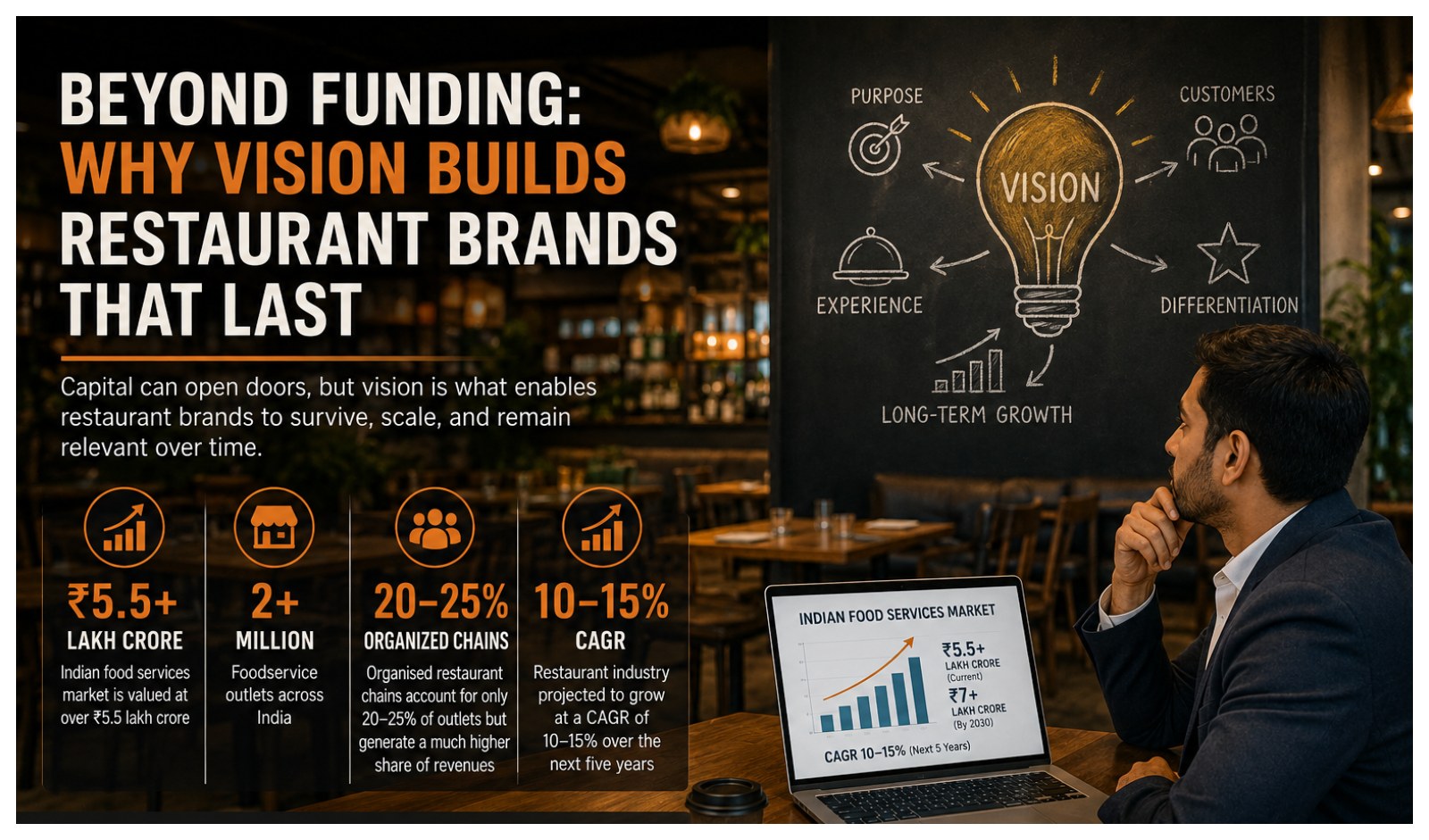
While capital, prime locations, striking interiors, and marketing are essential ingredients for launching a restaurant, they rarely build enduring brands. Vision does. The most successful restaurant companies, both globally and in India, have not scaled simply because they had the deepest pockets, but because they possessed a clear purpose, a deep understanding of their customers, and a differentiated position in the market. Capital can open doors, but vision is what enables restaurant brands to survive, scale, and remain relevant over time.
With Indian food services market valued at over ₹5.5 lakh crore and expected to surpass ₹7 lakh crore by 2030, alongside more than 2 million foodservice outlets, the opportunity for scalable, vision-led brands has never been greater. The restaurant industry is projected to grow with a CAGR of 10-15 percent over the next five years.
What Vision Means for Restaurant Growth
Vision in the restaurant business is far more than a mission statement; it is the strategic foundation that shapes a brand's purpose, customer proposition, experience and long-term market position. It determines whether a restaurant aims to be a premium dining destination, a value-driven family brand, a health-focused concept, a quick-service chain, or a specialist in regional cuisine.
“Vision goes beyond décor, menus, or expansion plans. It is a clear understanding of why a restaurant exists, the experience it wants to create, and the role it wants to play in people’s lives. It influences every decision, from concept development and menu curation to service standards and guest engagement,” shared Satish Koppula, Chairman, Pangeo.
In a market where organised restaurant chains account for only 20–25 percent of outlets but generates a significantly larger share of revenues through stronger branding, operational excellenceand customer trust, having a clear vision is a key differentiator.
“A strong vision provides clarity during periods of growth, helping businesses stay true to their identity while adapting to changing consumer preferences. At Brooks and Bonds, we believe that vision creates consistency, purpose, and identity, while capital simply enables its execution,” added PriyeshBusetty, Co-founder, Brooks and Bonds.
Why Capital Without Vision Fails
Capital can launch restaurants, but it rarely guarantees long-term success. Industry estimates suggest that nearly 60% of restaurants in India and globally shut down within their first three years, despite substantial investments in prime locations, fit-outs, equipment, and marketing. More often than not, the reasons for failure lie elsewhere: weak operations, poor differentiation, inconsistent customer experiences, and an inability to build customer loyalty. In an increasingly competitive market, money may help open doors, but vision, execution, and a clear understanding of the consumer are what determine whether a restaurant survives and thrives.
“Capital buys you a seat at the table, but vision is why people actually want to sit with you. The biggest misconception in the Indian restaurant scene right now is that a big budget equals a big brand. It doesn’t. Money can build expensive interiors and buy aggressive marketing, but it can’t buy a soul. It can’t create cultural relevance or that gut-feeling of ‘belonging’ that makes a customer come back three times a week. That only comes from vision,” pointed Saket Agarwal, Founder of Manifest Hospitality.
On an investor perspective, Sharad Bansal, Founder, Warmup Ventures who has invested in Boba Bhai, Nothing Before Coffee and other brands said, "We invest in seed and pre-seed stages and at that time, numbers are limited. While there are few numbers or no number, the vision is very important for us and how scalable it can become as a brand and practical action plan is very important. For eg: If a founder plan to open 500 outlets in the country, how that can be visualized and how they can scale. The vision should be clear on how to scale and how to target various cities and customers. When you raise a VC capital, then you have to plan an exit to the VC as well."
While capital addresses short-term needs such as rent, equipment, and working capital; vision addresses long-term needs such as brand positioning, customer loyalty, innovation, market relevance and scalability.
How Vision Creates Competitive Advantage
In today's crowded restaurant market, competitive advantage is driven less by location or marketing budgets and more by a clear vision.
Busetty noted, “Purpose provides authenticity, innovation keeps the brand relevant and guest experience builds loyalty. When these elements are aligned under a clear vision, they create a distinct market position that competitors find difficult to replicate.”
Vision also fuels innovation through digital ordering, loyalty programs, AI-powered operations, and sustainable practices, enabling restaurants to stay relevant and create lasting competitive advantage.
Why Investors Often Back Vision before Numbers
Beyond financial performance, investors evaluate a founder's vision, brand differentiation, market relevance, and ability to scale without compromising quality. Strong concepts with a clear purpose and long-term strategy frequently attract funding even in the early stages as investors recognize that financial results reflect the present, while vision signals future growth and value creation.
“Investors are smart they’re betting on the jockey, not just the horse. They back vision because numbers only tell you where a business is, but vision tells you where it can go when the trends shift,” commented Agarwal.
When a founder is clear on their 'Why,' every detail from the lighting to the service feels intentional. That’s what allows a brand to scale without losing its spirit. With this, one thing is clear: capital is just the fuel, but vision is the final destination.
Vijetha Iyer
Content Editor
Working as a Content Editor with Restaurant India. I have worked in various sectors like food and beverage sector, chemicals, pharma, nutraceuticals, now specially focusing on restaurant side. But my core knowledge was always on content. Be it writing poems to verses, I always loved writing and have been exploring my career on the same. In Restaurant India, I deliver insightful stories, take interviews of various brands and update the audiences about the newest happenings in the restaurant industry.









































